Compare · Cellulose fibre vs polyester · We sell both
Cellulose fibre vs polyester, which one goes where.
For a ceiling, pumped-in cellulose fibre: one seamless blanket over the joists and the water pipes, no gaps. For underfloor or a dust-sensitive home, polyester batts. I sell both, so I’ve no reason to push either.
These are my own two products: Comfort Zone® cellulose fibre that we make in Tiaro, and the polyester batts I rate as the King of batts. I don’t have a dog in the fight between them. This page lays out which one actually belongs in which part of your house.


Comfort Zone insulation.team
Family-owned insulation manufacturer, making comfy homes since 1986
One seamless blanket
a finished cellulose fibre ceiling in Ipswich: no joins, no gaps, joists covered
Real reviews, real jobs
What our customers say
Genuine Google & hipages reviews from Comfort Zone customers across SE Queensland.
- J
Jessa B.
Brisbane
“It dropped about 4 degrees straight away, and we added another 3 with the second job. I appreciate Peter's honesty, and the team showed pictures before and after.”
- Ahipages
Angela M.
SE Queensland
“The fact that I can't even tell it's 6 degrees outside when I wake up in the morning speaks for itself. Have wasted so much money attempting to heat and cool an uninsulated home. Worth every $.”
- I
Iain V-B.
Brisbane
“Quick and polite service. Great follow-up advice and photos sent for our records. Above and beyond what we expected. Would highly recommend.”
- Ghipages
Gerry S
Fitzgibbon, 2023
“I used Comfort Zone and they have a done an excellent job.”
- Jhipages
Jung K
Riverhills, 2023
“An experienced family operation. Highly recommend. Thank you for the great job!”
- Dhipages
David H
Sunshine Coast, 2021
“Completed the job as quoted and to a high standard. Great personal service. Would highly recommend Comfort Zone for ceiling installation work.”
- Bhipages
Benjamin H
Carseldine, 2019
“Very good explanation about their works. Advice of existing problems with the roof. Clean work. Very professional.”
- Ihipages
Ian G
Burnside, 2019
“Good information, communication and professionalism.”
- Dhipages
Danny D
Boondall, 2018
“He explained everything he was going to do and the different types of insulation they used. He talked through the different options but made a recommendation for the one most people use, which is the one I chose. He was very understanding towards what I needed and not about himself.”
- Ghipages
Graham R
Riverhills, 2018
“Comfort Zone. Turned up ahead of time, completed in about 2 hours, cleaned up. All good. Very motivated installation team.”
- Ahipages
Alex B
West Ipswich, 2018
“Fast, friendly, efficient.”
- Lhipages
Luke D
Mcdowall, 2017
“Peter did a good job. It was a quick and clean service. I'm happy to recommend!”
- Bhipages
Brendon
Brays Creek, 2016
“Peter supplied and installed roof insulation for me. He was very informative and provided good advice.”
- Thipages
Trevor G
Brookside Centre, 2016
“Excellent tradesmen from Comfort Zone Insulation. They were punctual and cleaned up after. Highly recommended.”
- Jhipages
John G
Beaudesert, 2019
“Peter is an honest person who provided me with the information I wanted then performed a good job with great results for the benefit of myself and my family.”
- Phipages
P Peter
Alstonvale, 2024
“Connected with Comfort Zone Insulation and would recommend them”
- Nhipages
Nola M
Birtinya, 2024
“They were courteous and competent.”
- Jhipages
Jennifer's E
Upper Caboolture, 2024
“Excellent customer service. Highly recommended. Has a profound knowledge of insulation products and has the best interest of his customer.”
- Jhipages
Jennifer
Upper Caboolture, 2024
“Excellent customer service. Highly recommend. Has a profound knowledge of insulation products and has the customer best interest.”
- Dhipages
Diane A
Ormeau, 2024
“Peter and crew did a great job I would definitely recommend them”
- Thipages
Timea
Highland Park, 2023
“I was extremely satisfied with the service they provided. They gave a very thourough explanation of the materials used, the way the work will be carried out and the price I had to pay was the exact amount quoted, no hidden costs included. They arrived on time, well prepared and workwas carried out exactly how they said it would be, they were super efficient, well prepared and were kind enough to even clean up after themselves. The services they provided was second to none! I don't hesitate to recommend them for any insulation job!”
- Mhipages
Mark
Pottsville, 2017
“Michelle, we are done - Peter from comfort zone insulation was very helpful. very honest with his recommendations - in fact he told me that the product my daughter had if installed correctly was superb. Thanks Peter you are a champion and i would recommend you to any person that was wanting professional advice and old school service.”
- Jhipages
Jessica
Pottsville, 2016
“This business offers a fantastic product that other businesses did not. Pump in ceiling insulation. Knowledge of the industry second to none.”
- Jhipages
Jack
Pottsville, 2023
“Excellent communication and informative. Professional.”
- Thipages
Tony P
Redland Bay, 2023
“Very knowledgeable about insulation”
- Shipages
Steve
Redland Bay, 2017
“Excellent job and reasonable price.”
- Bhipages
Bruce H
Kuluin, 2023
“Prompt and efficient quoting.”
- Ghipages
Gerry S
Fitzgibbon, 2023
“I used Comfort Zone and they have a done an excellent job.”
- Thipages
Tamara
Underwood, 2023
“Peter is honest, hard-working and came on time. Knew excally what he was talking about and answered my questions. Would 100% recommend”
- Shipages
Sterling G
Ashgrove, 2023
“Comfort Zone were very knowledge with great communication and follow up”
- Ghipages
Graham R
Riverhills, 2018
“Comfort Zone. Turned up ahead of time completed in +- 2 hours cleaned. All good. Very motivated installation team”
- Jhipages
Jung K
Riverhills, 2023
“An experienced family operation. Highly recommend. Thank you for the great job!”
- Khipages
Kathy A
North Lakes, 2023
“We connected with Peter through HiPages and he was prompt, professional and even came back after the job was complete to assist with a question we had. We would highly recommend Peter for further insulation works.”
- Dhipages
David H
Sunshine Coast, 2021
“Completed the job as quoted and to a high standard. Great personal service. Would highly recommend Comfort Zone for ceiling installationn work.”
- Shipages
Sue H
Sunshine Coast, 2021
“Incredible customer service”
- Ehipages
Eileen C
Cedar Vale, 2021
“Quality work, good customer service, prompt”
- Chipages
Craig M
Woody Point, 2021
“Called within 5 minutes of request. Very knowledgeable and explained job in great detail, provide great advice in prior preparation for works required. Very friendly and helpful.”
- Jhipages
Jenny C
Plainland, 2021
“Although I did not hire Peter I was impressed with the initial contact and the knowledge he was willing to impart. I was treated with respect which I appreciated. I would have hired but I received a lower quote.”
- Qhipages
Quinton
Coomera, 2020
“Professional installation without any short cuts. True to their word with high integrity. Response from Comfort Zone Insulation”
- Ghipages
Gary P
West Kempsey, 2020
“Came & Gave a free quote”
Why you can trust this comparison
I don’t have a dog in this fight.
Most insulation comparisons you’ll read online are written by someone who only sells one product, so the answer is always “buy the thing I sell.” This one’s different. I sell both of these products. We manufacture the Comfort Zone® cellulose fibre ourselves in Tiaro, and we stock and fit the polyester batts every week. So when I tell you cellulose fibre belongs in your ceiling and polyester belongs under your floor, it’s just me matching the right product to the right cavity, the same way I’d do it in my own house.
That’s the whole credibility play, and it’s the truth: I make more on the cellulose fibre. But I’d never pump it under a floor. It’s the wrong tool for that job. When someone talks you out of their higher-margin product where it doesn’t belong, you can probably trust them when they say it’s the right one where it does.
“I sell both. I’ve got no reason to push one over the other. I just put the right product in the right part of your house.”Peter Johnson, Comfort Zone Insulation Team

Comfort Zone insulation.team
Family-owned insulation manufacturer, making comfy homes since 1986
The short version
Cellulose fibre in the ceiling. Polyester under the floor (or for a dust-sensitive home). Two good products, two different jobs.
The same ceiling job, side by side.
Here’s a good polyester ceiling next to a finished cellulose fibre ceiling. The polyester job is a tidy one. My team fitted it and I’d defend every batt in it. But look at what each product can’t help being. A batt job is made of pieces: every piece cut to fit its bay, with joins and edges where the pieces meet. The pumped blanket is one piece from wall to wall. No joins, no gaps and nothing left bare.

Comfort Zone insulation.team
Family-owned insulation manufacturer, making comfy homes since 1986
Comfort Zone insulation.team
Family-owned insulation manufacturer, making comfy homes since 1986

Comfort Zone insulation.team
Family-owned insulation manufacturer, making comfy homes since 1986
Cellulose fibre owns the ceiling.
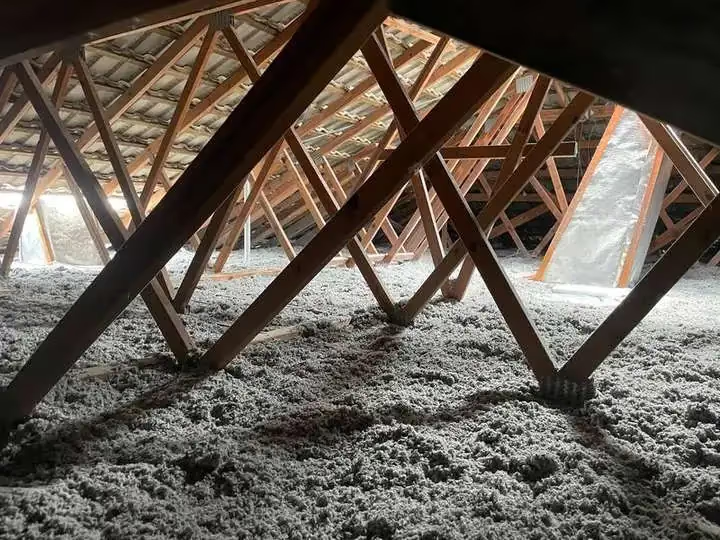
The ceiling is a sealed cavity, and that’s exactly where a pumped loose-fill product wins. Cellulose fibre goes in as one seamless blanket with full contact across every inch: no cutting, no joins, no gaps. That matters because an R-rating only counts if there are no gaps, and a batt has to be cut to fit every bay, so it always leaves some. The pumped blanket also gets into the awkward corners a batt could never reach.
The joists are the weak spot in your roof. A batt sits between the joists, which leaves every timber top bare, and bare timber lets heat straight through. I’ve felt it with my own hand: warm stripes across a plaster ceiling on a summer afternoon, one over every uncovered joist. Pumped cellulose fibre covers the tops of the joists as part of the one blanket, so the timber is buried along with everything else. Polyester batts can’t do that; no batt can.
The blanket buries your water pipes too. Your hot and cold water pipes run through the roof cavity, and in summer that cavity is an oven. That’s why the cold tap can run hot on a January afternoon. When we pump a ceiling, the cellulose fibre covers those pipes along with the joists, and in my experience that helps stop the cold tap running hot. Polyester batts can’t insulate your water pipes: they sit between the joists while the pipes stay up in the hot air.
It works the other way in winter. A buried hot-water pipe holds its heat on the run from the tank to the bathroom instead of shedding it into a cold roof, so the hot water turns up hotter and you waste less of what you have already paid to heat. Insulating the pipe is what does that, and burying it under the blanket insulates it for nothing extra.
People ask what happens to the wiring under all that. Nothing. It stays where the sparky put it, and if anybody needs to get at a cable later it is easy enough to find and flick out of the fibre with your hand, then let the blanket fall back over it. That is one of the practical differences between a loose blanket and a cut-to-fit batt.

Comfort Zone insulation.team
Family-owned insulation manufacturer, making comfy homes since 1986
On top of the seamless cover, cellulose fibre brings the edges polyester doesn’t: it’s borax-treated, so the insects that bring rats can’t survive in it (no insects, no food for rats), and in all our years pumping I’ve never once seen a rat nest built in it. We back that with the $1,000 Rodent Reward. The same borax treatment has been shown to slow fire spread. The full-contact cover also closes the cold spots where ceiling mould tends to form. There are no gaps for roof-cavity heat to hit the cool plaster and condense. And it carries a transferable Life-of-House guarantee. For a ceiling, that’s the product I’d put in my own mum’s house.
Polyester is the King of batts, and it owns the floor.
Under the floor, the picture flips. A crawlspace under a Queenslander is open, breezy and sometimes damp, and loose-fill cellulose fibre is made to sit captive in a sealed ceiling, not hang upside-down in the open air under your floorboards. So under the floor I don’t pump loose fill; I fit polyester. It’s hydrophobic, so the humidity under the house won’t waterlog it, it’s self-supporting between the joists, and it lifts out cleanly if a plumber ever has to get in and goes straight back after.
Polyester is the King of batts for a reason: locally made, non-itchy and safe to handle, with no glass fibre and no safety-data-sheet skin warning. It’s the same fibre as the doona on your bed. In 30-odd years I’ve never seen a polyester batt settle the way fibreglass does. That non-itch quality is also why it’s my pick for anyone with a dust or fibre sensitivity who can’t have a loose-fill product blown in. A fitted polyester batt is the gentler choice. It’s still a batt, so it has to be cut to fit every bay. But where it belongs, it’s exactly the right product.

Comfort Zone insulation.team
Family-owned insulation manufacturer, making comfy homes since 1986
Side by side
Cellulose fibre vs polyester: the clean comparison.
Ten things a homeowner actually cares about. On some, cellulose fibre wins; on some, polyester does; on plenty, the answer is “depends on the cavity.” I've flagged each one.
| What matters | Cellulose fibre (pump-in) Ceilings | Polyester batts Underfloor & sensitivities |
|---|---|---|
| Best for | Ceilings: pumped in as one seamless blanket over the whole roof cavity.depends on the job | Underfloor and ceilings for households that can't have a loose-fill product. |
| Install method & gaps | Pumped in dry: full contact across every inch of the ceiling, no cutting and no joins, so no gaps. better here | Cut to fit every bay and corner. My team cuts each piece to fit. But a batt always has more joins and edges than a pumped blanket. |
| Joists & water pipes | The blanket goes in over the tops of the joists and buries the hot and cold water pipes with them. The joists are the weak spot in your roof, and pumping is the only way I know to cover them. better here | A batt is cut to sit between the joists, so the timber tops stay bare and the pipes sit out in the hot roof air. That's not the batt's fault; it's just what a cut-to-fit product can do. |
| Fire | Natural mineral fire treatment: shown to slow fire spread, and it chars and holds instead of melting. better here | Not something I'd sell polyester on either way. It isn't fire-rated as a selling point. |
| Pests & rodents | Borax keeps insects out, so there's no food for rats and no food for snakes. In all our years pumping I've never once seen a rat nest built in it, and we back that with our $1,000 Rodent Reward. better here | No pest treatment: like any batt, a determined mouse can nest in it. |
| Moisture & humidity | Hygroscopic: handles an incidental roof leak by absorbing it in one spot and drying out. Made for a sealed ceiling, not an open crawlspace.depends on the job | Hydrophobic: shrugs off moisture, which is exactly what you want in a breezy, sometimes-damp underfloor space. |
| Handling & sensitivities | Recycled-paper plant fibre, gentle to handle, but like any loose-fill it's dusty while we pump it in. | Soft, non-itchy fibre, no glass, no SDS skin warning, the gentler pick for a dust-sensitive household. better here |
| Settling over time | Installed to a specified density so it holds its thickness. In 6,000 jobs I've never seen our cellulose fibre settle.depends on the job | In 30-odd years I've never seen a polyester batt settle the way fibreglass does. |
| Removability | Can be vacuumed out and reinstalled if the ceiling is ever replaced.depends on the job | Lifts out cleanly so a plumber or electrician can get into the underfloor and put it back. |
| Guarantee | Carries a transferable Comfort Zone® Life-of-House Guarantee. We don't know of another insulation in Australia that does. better here | Backed by our Best Service Guarantee plus the manufacturer's product warranty. |
That’s the scorecard. Cellulose fibre wins where the cavity is sealed, the ceiling, on gaps, joists and pipes, fire, pests and the guarantee. Polyester wins where the space is open or the household is sensitive, underfloor and dust-sensitive homes. Neither one is the “better product” in the abstract; the better product is the one that fits the job. Want all three side by side, including the fibreglass batts I don’t recommend? See the full three-way comparison table. If wood fibre insulation is on your list too, here’s how wood-fibre insulation compares.
Straight answers
Cellulose fibre vs polyester: the questions I get asked most.
Cellulose or polyester, which one should I actually use?+
It depends on the cavity. For a ceiling, I'd use pumped-in cellulose fibre every time: it goes in as one seamless blanket with no gaps, it covers the tops of the joists and buries your water pipes, it's borax-treated so pests won't live in it and it has been shown to slow fire spread, and it carries a transferable Life-of-House guarantee. For underfloor, where a loose-fill product is the wrong tool, polyester batts are exactly what I'd reach for. I sell and fit both, so I've got no reason to push one over the other. I just match the product to the job.
Why don't you pump cellulose under the floor?+
Because a crawlspace under a Queenslander is an open, breezy, sometimes-damp space, and loose-fill cellulose fibre is made to sit captive in a sealed ceiling cavity, not hang upside-down in the open air under your floorboards. Underfloor wants a batt that's cut to fit between the joists and stays put: polyester. It's hydrophobic so the humidity under the house doesn't waterlog it, it's non-itchy to handle, and it lifts out cleanly if a plumber ever needs to get in. So under the floor I use polyester, not loose fill, even though I make the cellulose fibre myself.
Is polyester insulation any good, or is it just a cheaper batt?+
Polyester is the King of batts, a solid product, and I fit it every week. It's locally made, non-itchy and safe to handle, there's no nasty glass-fibre dust to wash off your work clothes, and it shrugs off moisture. In 30-odd years I've never seen a polyester batt settle the way fibreglass does. It's the right choice underfloor, and it's the right choice for anyone with a sensitivity who can't have a loose-fill product. It's still a batt, so it has to be cut to fit every bay. But if it has to be a batt, this is the one.
My cold tap runs hot in summer. Can insulation help with that?+
It can. Your hot and cold water pipes run through the roof cavity, and on a summer afternoon that cavity is an oven, so the water sitting in the cold pipe comes out warm until it clears. When we pump a ceiling, the cellulose fibre blanket buries those pipes along with everything else, and in my experience that helps stop the cold tap running hot. A polyester batt can't do that: it's cut to sit between the joists, so the pipes stay up in the hot air. It's one of the quiet reasons I put cellulose fibre in ceilings.
I'm sensitive to dust. Is polyester or cellulose better for me?+
If you've got a genuine dust or fibre sensitivity, polyester is usually the gentler choice: it's a soft, non-itchy fibre with no glass in it and no safety-data-sheet skin warning. Our cellulose fibre is made from recycled paper and is gentle to handle too. But like any loose-fill it's dusty while we're pumping it in, so for a sensitive household, fitted polyester batts can be the easier call. Tell me about the sensitivity when I quote and I'll steer you to whichever product suits your home and your health best.
See it for yourself
Watch: cellulose fibre vs the batts.
Seamless cellulose vs polyester batts
A quick demonstration of how pumped-in cellulose fills a space seamlessly where cut polyester batts leave gaps.
Read the transcript
I'm just demonstrating the difference between cellulose fibre insulation as opposed to polyester batts, but if you put a flame on cellulose fibre it doesn't recede from the flame. It's the only insulation on the market that doesn't, so if this comes into your roof and sitting beside your joist it can actually protect your joist from the heat of the flame. So that's one of the reasons why it's far more fire retardant. If you imagine the difference, that's polyester batts. They're a fantastic insulation, great batt, but if you have that in your roof it just melts away and exposes your joists to the flame, and also produces gases as well. Just on a side note, we've actually treated this batt with the same product as we treat the cellulose with and you can see it's a lot more fire retardant with that treatment.
How the different insulation types behave
Peter runs through how the common insulation types actually behave in a real Queensland roof.
Read the transcript
Hi there, Peter here from Comfort Zone Insulation. So if you wanted to know how different insulations perform under a flame test side by side, I'll just show you. So here we've got a fibreglass batt. They're very, very common. They're one of the cheaper of the insulation products on the market. Then we've got the polyester batt. The polyester batt's a non-allergenic, non-itchy batt and it's really quite good as far as an insulation goes. It's harder for rats and mice to build nests in it than it is for the earth form. And here we've got the cellulose fibre insulation. Now here's a bit of polyurethane that we pulled out of a house the other day. It's commonly used on chook sheds and things like that. I don't think it complies with the standard for pumping into residential buildings, but every now and again people want to put it in because they think that it should. I'll just light up my little oxy torch here. I'll just show you. We've put the flame onto the fibreglass batt. You can see now, it's just trying to cut through the batt. Even though the batt doesn't catch on fire, there's nothing stopping that from burning your house down. Because the batt just melts away from the flame. The polyester has just been starting to burn. The gases coming off it are quite poisonous if you had a fire. Yeah. Polyurethane, that stuff is dangerous. It just catches fire. Very dangerous. It does a really black smoke. You wouldn't want that in your house. The one that I prefer is obviously the cellulose fibre. If we put a bit of flame on the side of the fibre, you can have a flame on there for a long time and it doesn't recede from the flame so therefore it can help protect your home in the fire and the flame just goes out. If we break that apart there, you'll see that the flame's only actually burned into there. A couple millimetres in the top. That's where it can protect your house from the fire and that's how they're still burning. Let me just put that out for safety's sake. That's where the cellulose will put out the risk of other things in the room. Often times we pump the cellulose over the top of polyester or fibreglass or polyurethane to make sure there's no fire. I hope that answers your questions and I hope that you have the same opinion as I am now that the cellulose is a far better option.
Did we sort your ceiling or your floors? Leave us a review.
A quick honest review genuinely helps a small family business, and helps the next person decide. Thank you.
Got photos or a video from the job? Here’s where to send them →
Not sure which one your house needs?
Tell me what you’re trying to fix (a hot ceiling, a cold floor, a dust sensitivity) and I’ll match the right product to the right cavity and give you a fixed-price quote within 48 hours for most houses. Cellulose fibre, polyester or both: I sell both, so I’ll just tell you what your house actually needs.
Peter Johnson
Owner / installer · Comfort Zone Insulation Team® · Since 1986
Want the bigger picture? Read why cellulose fibre wins in a ceiling, compare cellulose fibre vs fibreglass, or just get your quote started.
We make our cellulose fibre in Tiaro and we’re looking for installers to join the family. Ask about a Comfort Zone franchise territory.