Where we work · Climate Zone 5
Cellulose ceiling & underfloor insulation in Toowoomba, Darling Downs & Granite Belt.
Toowoomba's ~691m Range-top elevation gives it mild summers but cold, frosty Darling Downs winters, and the Granite Belt around Stanthorpe is colder still. This is Zone 5 country, where insulation has to hold heat in. We bring factory-direct cellulose up the Range from Tiaro.


Comfort Zone insulation.team
Family-owned insulation manufacturer, making comfy homes since 1986
Real reviews, real jobs
What our customers say
Genuine Google & hipages reviews from Comfort Zone customers across SE Queensland.
- J
Jessa B.
Brisbane
“It dropped about 4 degrees straight away, and we added another 3 with the second job. I appreciate Peter's honesty, and the team showed pictures before and after.”
- Ahipages
Angela M.
SE Queensland
“The fact that I can't even tell it's 6 degrees outside when I wake up in the morning speaks for itself. Have wasted so much money attempting to heat and cool an uninsulated home. Worth every $.”
- I
Iain V-B.
Brisbane
“Quick and polite service. Great follow-up advice and photos sent for our records. Above and beyond what we expected. Would highly recommend.”
- Ghipages
Gerry S
Fitzgibbon, 2023
“I used Comfort Zone and they have a done an excellent job.”
- Jhipages
Jung K
Riverhills, 2023
“An experienced family operation. Highly recommend. Thank you for the great job!”
- Dhipages
David H
Sunshine Coast, 2021
“Completed the job as quoted and to a high standard. Great personal service. Would highly recommend Comfort Zone for ceiling installation work.”
- Bhipages
Benjamin H
Carseldine, 2019
“Very good explanation about their works. Advice of existing problems with the roof. Clean work. Very professional.”
- Ihipages
Ian G
Burnside, 2019
“Good information, communication and professionalism.”
- Dhipages
Danny D
Boondall, 2018
“He explained everything he was going to do and the different types of insulation they used. He talked through the different options but made a recommendation for the one most people use, which is the one I chose. He was very understanding towards what I needed and not about himself.”
- Ghipages
Graham R
Riverhills, 2018
“Comfort Zone. Turned up ahead of time, completed in about 2 hours, cleaned up. All good. Very motivated installation team.”
- Ahipages
Alex B
West Ipswich, 2018
“Fast, friendly, efficient.”
- Lhipages
Luke D
Mcdowall, 2017
“Peter did a good job. It was a quick and clean service. I'm happy to recommend!”
- Bhipages
Brendon
Brays Creek, 2016
“Peter supplied and installed roof insulation for me. He was very informative and provided good advice.”
- Thipages
Trevor G
Brookside Centre, 2016
“Excellent tradesmen from Comfort Zone Insulation. They were punctual and cleaned up after. Highly recommended.”
- Jhipages
John G
Beaudesert, 2019
“Peter is an honest person who provided me with the information I wanted then performed a good job with great results for the benefit of myself and my family.”
- Phipages
P Peter
Alstonvale, 2024
“Connected with Comfort Zone Insulation and would recommend them”
- Nhipages
Nola M
Birtinya, 2024
“They were courteous and competent.”
- Jhipages
Jennifer's E
Upper Caboolture, 2024
“Excellent customer service. Highly recommended. Has a profound knowledge of insulation products and has the best interest of his customer.”
- Jhipages
Jennifer
Upper Caboolture, 2024
“Excellent customer service. Highly recommend. Has a profound knowledge of insulation products and has the customer best interest.”
- Dhipages
Diane A
Ormeau, 2024
“Peter and crew did a great job I would definitely recommend them”
- Thipages
Timea
Highland Park, 2023
“I was extremely satisfied with the service they provided. They gave a very thourough explanation of the materials used, the way the work will be carried out and the price I had to pay was the exact amount quoted, no hidden costs included. They arrived on time, well prepared and workwas carried out exactly how they said it would be, they were super efficient, well prepared and were kind enough to even clean up after themselves. The services they provided was second to none! I don't hesitate to recommend them for any insulation job!”
- Mhipages
Mark
Pottsville, 2017
“Michelle, we are done - Peter from comfort zone insulation was very helpful. very honest with his recommendations - in fact he told me that the product my daughter had if installed correctly was superb. Thanks Peter you are a champion and i would recommend you to any person that was wanting professional advice and old school service.”
- Jhipages
Jessica
Pottsville, 2016
“This business offers a fantastic product that other businesses did not. Pump in ceiling insulation. Knowledge of the industry second to none.”
- Jhipages
Jack
Pottsville, 2023
“Excellent communication and informative. Professional.”
- Thipages
Tony P
Redland Bay, 2023
“Very knowledgeable about insulation”
- Shipages
Steve
Redland Bay, 2017
“Excellent job and reasonable price.”
- Bhipages
Bruce H
Kuluin, 2023
“Prompt and efficient quoting.”
- Ghipages
Gerry S
Fitzgibbon, 2023
“I used Comfort Zone and they have a done an excellent job.”
- Thipages
Tamara
Underwood, 2023
“Peter is honest, hard-working and came on time. Knew excally what he was talking about and answered my questions. Would 100% recommend”
- Shipages
Sterling G
Ashgrove, 2023
“Comfort Zone were very knowledge with great communication and follow up”
- Ghipages
Graham R
Riverhills, 2018
“Comfort Zone. Turned up ahead of time completed in +- 2 hours cleaned. All good. Very motivated installation team”
- Jhipages
Jung K
Riverhills, 2023
“An experienced family operation. Highly recommend. Thank you for the great job!”
- Khipages
Kathy A
North Lakes, 2023
“We connected with Peter through HiPages and he was prompt, professional and even came back after the job was complete to assist with a question we had. We would highly recommend Peter for further insulation works.”
- Dhipages
David H
Sunshine Coast, 2021
“Completed the job as quoted and to a high standard. Great personal service. Would highly recommend Comfort Zone for ceiling installationn work.”
- Shipages
Sue H
Sunshine Coast, 2021
“Incredible customer service”
- Ehipages
Eileen C
Cedar Vale, 2021
“Quality work, good customer service, prompt”
- Chipages
Craig M
Woody Point, 2021
“Called within 5 minutes of request. Very knowledgeable and explained job in great detail, provide great advice in prior preparation for works required. Very friendly and helpful.”
- Jhipages
Jenny C
Plainland, 2021
“Although I did not hire Peter I was impressed with the initial contact and the knowledge he was willing to impart. I was treated with respect which I appreciated. I would have hired but I received a lower quote.”
- Qhipages
Quinton
Coomera, 2020
“Professional installation without any short cuts. True to their word with high integrity. Response from Comfort Zone Insulation”
- Ghipages
Gary P
West Kempsey, 2020
“Came & Gave a free quote”
Where we work
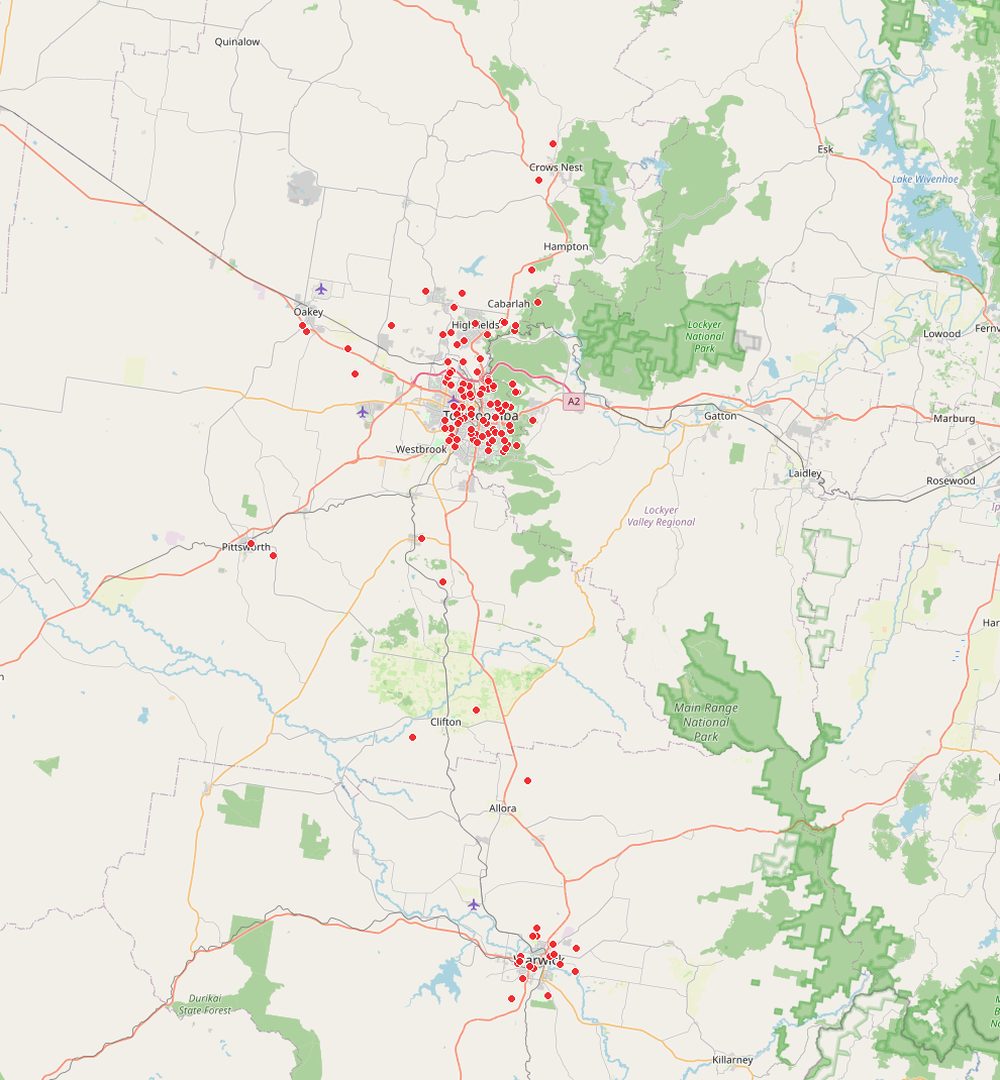
140+ Toowoomba homes — and what your neighbours say.
Every red dot on the map is a home near here we’ve quoted, advised or insulated (de-identified) — recent records only, a fraction of what we’ve done since 1986.
From a local
“The job was completed by Comfort Zone. I was contacted quickly and they were able to get the job done same day.”
“Good service, competitive price, quick timing to install”
“Prompt and professional Well priced”
The local picture
What Toowoomba, Darling Downs & Granite Belt homes actually need.
Toowoomba's elevation flips the usual Queensland story on its head: summers are genuinely mild (only about three days a year reach 35°C), but winters are cold, with frost on around 14 mornings a year and lows under 0°C. So heating load, not cooling, dominates, and deep, gap-free ceiling cellulose is the single biggest lever on comfort and the power bill, especially in the older Highfields and East Toowoomba timber homes. Head south to the Granite Belt and it gets serious: Stanthorpe is the coldest town in Queensland, apple, stone-fruit and wine country that holds the state record low of −10.6°C, gets real snow, and frosts on more than 40 mornings a year. With so many homes raised on stumps up there, an under-insulated house bleeds heat all winter, so top-grade ceiling insulation AND underfloor insulation both matter far more than they ever would on the coast.
What it costs
What ceiling insulation costs in Toowoomba, Darling Downs & Granite Belt.
As a rough guide, ceiling insulation runs $42–$61/m² including GST, depending on the product, your roof type and how hard the access is. A simple low-set roof with an easy manhole costs less per metre than a cut-up two-storey full of downlights, so I don’t publish one flat number for Toowoomba. Send me your address and I’ll measure your roof off Nearmap and give you a proper fixed-price quote within 48 hours, with no deposit to pay.
Recommended prices. Your local Comfort Zone team confirms your exact price in a written fixed-price quote.
Get a fixed-price quote for Toowoomba, Darling Downs & Granite Belt
Toowoomba in brief
Founded
Settled in 1849, a city since 1904 — one of Australia's oldest inland cities
People
142,163 in the city and 173,204 across the region (ABS 2021)
Industry
Built on farming and timber; today the Darling Downs' hub for health, education and retail
Setting
Perched 691 m up on the Great Dividing Range, about 125 km west of Brisbane
Why Comfort Zone
Cellulose insulation, by the family that makes it.
The only cellulose insulation maker still operating in Queensland.
We manufacture every bag ourselves in our own factory at Tiaro. The other Queensland cellulose makers have closed down over the years — these days our competitors buy their cellulose from us. Choose Comfort Zone and you’re dealing with the family who actually makes the product, start to finish.
We make our own cellulose
Most cellulose insulation sold in Australia is manufactured interstate — in Victoria, South Australia or WA. Ours is made right here in our own Tiaro factory, so you deal with the family who makes it, not a sales rep reselling someone else's product.
Three generations, since 1986
Peter learned the trade from his father, Lyle, and runs the business today with his sons. A real family business that's been insulating Queensland homes for nearly 40 years — not a franchise call-centre.
QR-code batch-tracked bags
Every bag we pump into your roof is QR-coded and tracked back to its production batch and your job — full traceability that even the big national brands can't offer. If a question ever comes up about your insulation, we can trace exactly what went in and when.
Toowoomba, Darling Downs & Granite Belt climate
The weather your insulation has to handle.
- Up on the Range
- 691 m on the Great Dividing Range — one of Australia's highest major cities, which is exactly why it runs so much cooler than the coast.
- Frosty mornings
- About 14 mornings a year at 2°C or below, and around 4 at or below freezing — genuine frost country for Queensland.
- Coldest on record
- −4.4°C on 12 July 1965 — genuine frost country for Queensland (BoM Toowoomba station 041103).
- Hot days (35°C+)
- Only about 3 a year — summers up here are mild by Queensland standards.
- Hottest on record
- 39.3°C, 6 January 1994 (Toowoomba).
- Annual rainfall
- About 944 mm across the long town record.
And it's trending warmer: Australia has heated about 1.5°C since 1910, and the Darling Downs is projected to cop many more days over 35°C by 2050 (BoM State of the Climate; Qld Government regional projections). A home that's comfortable now will lean on its insulation harder every decade — worth getting right once.
Climate outlook reviewed 2026-06-11; local job counts updated 2026-06-26. Sources: BoM: Toowoomba climate · BoM: Stanthorpe climate · QLD Gov: building climate zones.
Toowoomba, Darling Downs & Granite Belt at a glance
- Climate zone
- Climate Zone 5 — what R-value that needs
- Postcodes
- 4350, 4380
- Local picture
- Toowoomba is a regional city of ≈142,000; Stanthorpe (≈5,300) anchors the Granite Belt. Both are full of older, frost-exposed timber homes that reward a proper winter envelope.
Up on the Range this is NCC Climate Zone 5: warm temperate with genuinely cold winters, NOT the coastal Zone 2. Heating, not cooling, dominates here, so a deep, gap-free ceiling blanket (and underfloor on the old Queenslanders) is the single biggest comfort and power-bill lever.
What Zone 5 actually needs — straight from the NCC
Per the NCC 2022 (Housing Provisions, Part 13.2.3, Table 13.2.3f, on p.336), a Zone 5 ceiling needs about R3.0 of added insulation — and a deep, dense R3.0 cellulose blanket is exactly what we install as standard. That's only a touch more than the R2.5 the coast (Zone 2) asks for; the real Zone-5 difference is the cold winters, which is why a gap-free ceiling AND underfloor insulation matter far more up here than on the coast. Watch for quotes citing “R5.5+” as the ceiling figure — that's the whole-of-home “total-system” / 7-star NatHERS number, not the insulation an installer actually fits.
Read it yourself: NCC 2022 Housing Provisions, Part 13.2.3, Table 13.2.3f (p.336) — free from the ABCBThe season ahead — and why it matters for your insulation
Mid-2026 leaning toward El Niño, drier with clearer, frost-favouring winter nights on the Downs and Granite Belt. Reviewed each season.
Colder than you think
It’s colder around Toowoomba than in it.
Here's the thing most people miss: Toowoomba's height on the Range actually buffers the city — it sees milder summers and far fewer frosts than the lower, colder towns scattered around it. So if you're out on the Downs or up on the Granite Belt, you need a good winter envelope even more than Toowoomba itself does. The numbers tell the story:
| Town | Height | Avg July night | Frosts / year | Avg summer day |
|---|---|---|---|---|
| Stanthorpe (Granite Belt) | 784 m | 1.1°C | ~43 a year ❄ coldest | 27.5°C |
| Applethorpe | 872 m | 2.1°C | ~34 a year | 26.8°C |
| Cambooya | 476 m | 2.0°C | ~34 a year | 30.1°C |
| Oakey | 406 m | 3.0°C | ~25 a year | 31.1°C |
| Warwick | 475 m | 3.2°C | ~25 a year | 30.5°C |
| Dalby | 344 m | 4.1°C | ~13 a year | 32.0°C 🔥 hottest |
| Pittsworth | 520 m | 5.0°C | ~4 a year | 29.9°C |
| Toowoomba (city) | 691 m | 5.3°C | ~4 a year | 27.6°C |
| Toowoomba Airport | 641 m | 6.7°C | ~1 a year | 28.4°C |
- Of every town we cover, Stanthorpe is the coldest — a typical July night sits at just 1.1°C, and it frosts on about 43 mornings a year. It holds Queensland's coldest-ever reading: −10.6°C, set on 23 June 1961.
- Oakey frosts far harder than Toowoomba itself — about 25 frost mornings a year versus roughly 4 in the city (and only about 1 out at the Airport). If your floors are cold in Oakey, that's why.
- Dalby bakes in summer: a January average high of 32°C and about 24 days a year over 35°C — roughly eight times Toowoomba's hot-day count. Out there, insulation has to keep heat OUT as well as in.
- Even Cambooya, just south of town, runs colder than the Granite Belt's Applethorpe on frost count — about 34 frosty mornings a year. Cold air pools in the low spots.
- Toowoomba's height is a double-edged sword: it buffers the city, but the towns down off the Range and up on the Belt — Oakey, Warwick, Dalby, Stanthorpe — cop colder winters AND hotter summers, so good insulation matters there even more than it does in town.
Source: BoM Monthly Climate Statistics (all years of record), pulled 25 June 2026.
A bit about Toowoomba
We know this patch.
- Toowoomba sits at exactly 691 m on the crest of the Great Dividing Range — the second-most-populous inland city in Australia after Canberra.
- It's earned the name "The Garden City" — home to 150+ parks and gardens and the Carnival of Flowers every September, Australia's longest-running flower festival (first held in 1950).
- It gets genuinely cold for Queensland: brief snow flurries were even reported in Toowoomba on the morning of 17 July 2015 during a big eastern-Australia cold snap.
- The classic local home is the elevated timber Queenslander up on stumps — concentrated through East Toowoomba, Rangeville, Mount Lofty and Newtown — built up off the ground to catch the summer breeze underneath, which is exactly why those floors run cold in winter.
- Toowoomba 4350 is one of Queensland's biggest solar postcodes (4th overall) — 17,864 systems and 114,413 kW installed by early 2025. But solar makes power; it doesn't stop a home leaking heat.
Local links: BoM — Toowoomba climate averages · Toowoomba Regional Council · University of Southern Queensland (Toowoomba) · Toowoomba Carnival of Flowers
What we’d recommend in Toowoomba, Darling Downs & Granite Belt
The insulation that suits Toowoomba, Darling Downs & Granite Belt homes, and why.

Comfort Zone insulation.team
Family-owned insulation manufacturer, making comfy homes since 1986
Across the Downs and Granite Belt the winters are genuinely cold, so a deep, gap-free cellulose ceiling to hold heat in is the single biggest lever on comfort and heating costs — start here.

Comfort Zone insulation.team
Family-owned insulation manufacturer, making comfy homes since 1986
Stanthorpe is the coldest town in Queensland (record −10.6°C) and its historic apple-and-wine-country homes sit on stumps. Underfloor insulation is the standout second job here: it stops the frosty air chilling the floor all winter.

Comfort Zone insulation.team
Family-owned insulation manufacturer, making comfy homes since 1986
The Toowoomba Bypass and Warrego Highway create busy freight corridors; dense cellulose absorbs that highway noise better than lightweight fibreglass.
That’s what we see most in Toowoomba, Darling Downs & Granite Belt. But every home is different. Browse all our insulation services or ask for a quoteand we’ll tell you what yours needs.
Underfloor, done right
Why we push underfloor insulation hard for old Toowoomba homes

Comfort Zone insulation.team
Family-owned insulation manufacturer, making comfy homes since 1986
Here's the thing about a Toowoomba Queenslander. Those old homes were built up on stumps on purpose — up off the ground so the summer breeze runs under the floor and keeps the place cool. Brilliant for January. The problem is July. You're 691 metres up on the Range, you get four-odd mornings a year at or below freezing and about fourteen at 2 degrees or under, and all that cold air is sitting right under your bare floorboards. Timber on its own barely insulates — the Australian Government's own YourHome guide puts a bare timber floor at about R0.25, which is next to nothing. So your heat falls straight through the floor into that cold space underneath, and your feet feel it.
Now people ask me, can't you just throw some batts under there. You can — but batts made for between your ceiling joists aren't designed to hang under a floor. They sag, they pull away from the boards, and they leave air gaps. And gaps are the killer. YourHome says it straight: "even a small gap can greatly reduce the insulating value." The industry's own 2024 figures (ICANZ, built off CSIRO and NatHERS modelling) show that around 6% of gaps roughly halves your effective R-value — a rated R5 drops to about R2.4. The building code itself, the NCC, says insulation has to "maintain its position and thickness" to count. A drooping batt under your floor fails that test. That's why we use a custom-made, self-supporting polyester floor batt, fitted snug and held in full contact, so you keep the R-value you paid for.
And it's not only a winter job. YourHome recommends insulating under the floor specifically for "cool climates and climates that require heating in winter and cooling in summer" — that's Toowoomba to a tee. But I'll always give you the honest part too: in some warmer homes underfloor isn't worth it, and the government guidance says exactly that, so we'll have a look and tell you straight whether your floor is worth doing. For a classic elevated Toowoomba Queenslander with a cold open space underneath, though? A properly installed, gap-free underfloor job is one of the best comfort wins you'll get — no more cold boards underfoot in a Darling Downs winter.
Watch: real jobs
See the work for yourself
A few from our own channel: does cellulose really settle, the flame test, and why we pump it in instead of laying batts.
Filmed on real jobs over the years — our methods, safety standards and products have moved on since. Subscribe to the channel for more.
The difference
On a Toowoomba roof: what we run into, and how we do it.

Comfort Zone insulation.team
Family-owned insulation manufacturer, making comfy homes since 1986
Comfort Zone insulation.team
Family-owned insulation manufacturer, making comfy homes since 1986

Comfort Zone insulation.team
Family-owned insulation manufacturer, making comfy homes since 1986
Comfort Zone insulation.team
Family-owned insulation manufacturer, making comfy homes since 1986
Where we’ve helped — suburb by suburb
148+ Toowoomba homes, and the postcode for yours.
Find your suburb below — the number is how many homes near you we’ve helped with advice or work. These are only the last few years we’ve kept digital records for, a fraction of what we’ve done since 1986, so if there’s no count next to your suburb yet, be the first on your street.
Toowoomba & suburbs (4350 · 4352)
92+ homes helped here
- Warwick14 homes
- Centenary Heights9 homes
- Harristown9 homes
- East Toowoomba7 homes
- Toowoomba7 homes
- Stanthorpe7 homes
- Middle Ridge5 homes
- Athol5 homes
- Newtown4 homes
- South Toowoomba3 homes
- Wilsonton2 homes
- Kearneys Spring2 homes
- Rangeville2 homes
- North Toowoomba2 homes
- Drayton2 homes
- Glenvale2 homes
- Rockville2 homes
- Westbrook2 homes
- Darling Heights2 homes
- Crows Nest2 homes
- Top Camp1 home
- Gowrie Mountain1 home
- Toowoomba Citybe the first
- Mount Loftybe the first
- Wilsonton Heightsbe the first
- Cranleybe the first
- Harlaxtonbe the first
- Wyallabe the first
- Prince Henry Heightsbe the first
- Redwoodbe the first
- Mount Kynochbe the first
- Cotswold Hillsbe the first
- Blue Mountain Heightsbe the first
- Mount Rascalbe the first
- Charltonbe the first
- Gowrie Junctionbe the first
- Wellcampbe the first
- Carringtonbe the first
- Finniebe the first
- Torringtonbe the first
- Cotton Valebe the first
- Jenningsbe the first
Darling Downs towns (4355–4405)
33+ homes helped here
- Highfields4 homes
- Meringandan West3 homes
- Kingsthorpe3 homes
- Pittsworth3 homes
- Oakey3 homes
- Cabarlah2 homes
- Clifton2 homes
- Crows Nest2 homes
- Dalby2 homes
- Withcott2 homes
- Kleinton1 home
- Postmans Ridge1 home
- Hampton1 home
- Cambooya1 home
- Greenmount1 home
- Nobby1 home
- Goombungee1 home
- Meringandanbe the first
- Gehambe the first
- Hodgson Valebe the first
- Wyreemabe the first
- Umbirambe the first
- Murphys Creekbe the first
- Spring Bluffbe the first
- Blanchviewbe the first
- Groomsvillebe the first
- Pecheybe the first
- Ravensbournebe the first
- Ramsaybe the first
- Vale Viewbe the first
- Cooyarbe the first
- Jondaryanbe the first
- Maclaganbe the first
- Perangabe the first
- Kulpibe the first
Granite Belt & Southern Downs (4370 · 4380)
23+ homes helped here
- Warwick14 homes
- Stanthorpe7 homes
- Allora1 home
- Glen Aplin1 home
- Applethorpebe the first
- Yanganbe the first
- Killarneybe the first
- Severnleabe the first
- Ballandeanbe the first
Counts are de-identified contacts from our records — homeowners we’ve helped with advice or work, not just completed jobs. See the customer map.
Your local team
Toowoomba, Darling Downs & Granite Belt is looked after directly by Comfort Zone HQ — for now.
Right now Toowoomba, Darling Downs & Granite Belt is served straight out of our family HQ and Tiaro factory, the same people who make the cellulose. Every job is done to one standard, photographed, and the photos checked before you’re invoiced.
Want to run Toowoomba as your own business?
We’re looking for the right local owner-operator for this patch. If you’re passionate about the building trade — or you already run a business that fits, like air-conditioning, pest control, roofing or solar, and you want a high-margin add-on product to take to the customers you already have — we’ll train you from the ground up. You don’t need insulation experience; you need the right attitude and a patch you want to own. We make the product, we teach you to install and sell it, and you build a family business of your own — backed by the factory.
Toowoomba questions
Insulation in Toowoomba — your questions, answered.
Does it really get cold enough in Toowoomba to bother insulating?
Yes — colder than most of Queensland. We're 691 metres up on the Great Dividing Range, the record low is −4.4°C, and the town sees about 14 mornings a year at 2°C or below with frequent frost and fog. It even had brief snow flurries on 17 July 2015. Heating, not cooling, is what drives the power bill up here, and a deep, gap-free ceiling is the biggest lever you've got on it.
Why do you push underfloor insulation so hard for old Toowoomba homes?
Because the classic local home is the elevated timber Queenslander on stumps — built up off the ground to catch the summer breeze, which is great in January but means cold air sits right under your floorboards in July. Bare timber barely insulates (about R0.25 per YourHome), so heat falls straight through. A properly fitted, self-supporting underfloor batt stops that — no more cold boards underfoot.
Can't I just put batts under my floor myself?
You can, but batts made for ceilings aren't designed to hang under a floor — they sag, pull away from the boards and leave gaps. And gaps wreck the R-value: YourHome says "even a small gap can greatly reduce the insulating value," and 2024 ICANZ figures show around 6% of gaps roughly halves your effective R-value. We use a custom-made, self-supporting polyester floor batt held in full contact, so you actually keep the R-value you paid for.
Will underfloor insulation help in summer too, or just winter?
Mostly it's a winter comfort win up here — stopping cold floors and draughts. YourHome does recommend underfloor for "climates that require heating in winter and cooling in summer," so there's a summer benefit too. But it's not automatic: the government's own guidance notes that in some warmer homes underfloor can actually add to the summer cooling load. So we look at your specific floor and tell you straight whether it's worth doing.
It's colder out where I am than in Toowoomba — does that change things?
Almost certainly for the better. Toowoomba's height actually buffers the city — the towns around it cop it harder. Oakey frosts about 25 mornings a year against Toowoomba's ~4; Stanthorpe frosts ~43 and holds the state record of −10.6°C; Dalby then bakes through summer with ~24 days over 35°C. If you're out on the Downs or up on the Granite Belt, a good insulation envelope matters even more than it does in town.
Toowoomba has loads of solar — do I still need insulation?
Absolutely. Toowoomba 4350 is the 4th-biggest solar postcode in Queensland — but solar makes power, it doesn't stop your home leaking heat. The cheapest kilowatt is the one you never have to use. Insulating the ceiling (and the floor on an old Queenslander) cuts how hard your heating and cooling have to work in the first place, so your solar goes further.
Why cellulose instead of batts for a Toowoomba home?
Cellulose is pumped in to a set density so it fills the whole space with no gaps — and gaps are what destroy real-world R-value. In an older Queenslander full of quirky angles, penetrations and draughty spots, a seamless full-contact fill outperforms batts that leave gaps. It's also borate-treated, so rodents and insects won't live in it the way they nest in loose batts.
Do you actually come out to Toowoomba and the Downs, or just quote online?
We come out. It's a straight run up the Range from our Tiaro factory, and we cover Toowoomba and the surrounding Downs and Granite Belt towns — Highfields, Oakey, Pittsworth, Crows Nest, Warwick and Stanthorpe included. We measure your job, send a detailed fixed-price quote, and do every job to one standard with the work photographed before you're invoiced.
Had your Toowoomba, Darling Downs & Granite Belt home done? A review helps your neighbours choose well.
A quick honest review genuinely helps a small family business, and helps the next person decide. Thank you.
Got photos or a video from the job? Here’s where to send them →
Get a quote for your Toowoomba, Darling Downs & Granite Belt home.
Tell us your address and a few details and we’ll measure online and send a detailed, fixed-price quote. Phone 0414 586 315.