J
Jessa B.
Brisbane
“It dropped about 4 degrees straight away, and we added another 3 with the second job. I appreciate Peter's honesty, and the team showed pictures before and after.”
Roof, ceiling & underfloor insulation · Brisbane & SE Queensland
A proper, fixed-price quote from a tradesman who actually crawls through roofs. No deposits, no day-of surprises, just a job done right the first time.
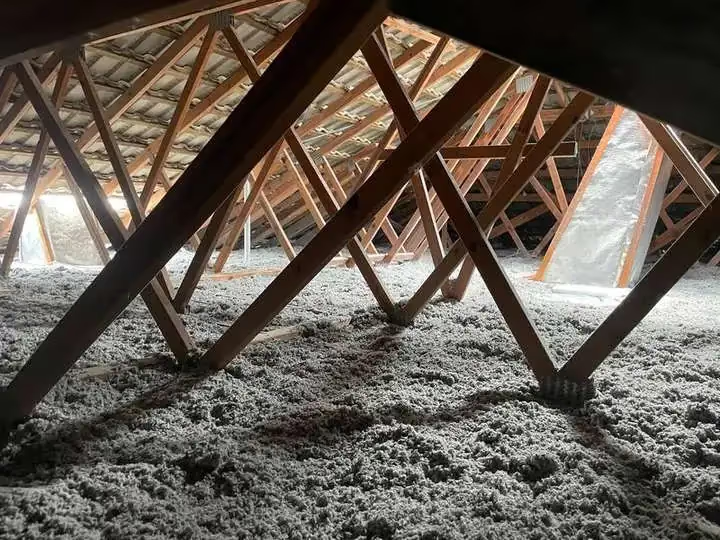
Comfort Zone Insulation Team is a family business that makes its own cellulose insulation in Tiaro and installs it across Brisbane and South East Queensland, pumped in as a seamless blanket with no gaps, with a natural mineral treatment against fire and pests, to keep your home cooler in summer and warmer in winter, since 1986. Here’s the full rundown on roof insulation in Brisbane.
All of the comfort. None of the gaps, pests, mould or itch. Make your home a Comfort Zone today. Ask us how.
$1,000 Rodent Reward — we’ve never once seen a rat nest in our pumped cellulose. Terms apply.

Comfort Zone insulation.team
Family-owned insulation manufacturer, making comfy homes since 1986
This is cellulose
one seamless blanket, no gaps
Real reviews, real jobs
Genuine Google & hipages reviews from Comfort Zone customers across SE Queensland.
Jessa B.
Brisbane
“It dropped about 4 degrees straight away, and we added another 3 with the second job. I appreciate Peter's honesty, and the team showed pictures before and after.”
Angela M.
SE Queensland
“The fact that I can't even tell it's 6 degrees outside when I wake up in the morning speaks for itself. Have wasted so much money attempting to heat and cool an uninsulated home. Worth every $.”
Iain V-B.
Brisbane
“Quick and polite service. Great follow-up advice and photos sent for our records. Above and beyond what we expected. Would highly recommend.”
Gerry S
Fitzgibbon, 2023
“I used Comfort Zone and they have a done an excellent job.”
Jung K
Riverhills, 2023
“An experienced family operation. Highly recommend. Thank you for the great job!”
David H
Sunshine Coast, 2021
“Completed the job as quoted and to a high standard. Great personal service. Would highly recommend Comfort Zone for ceiling installation work.”
Benjamin H
Carseldine, 2019
“Very good explanation about their works. Advice of existing problems with the roof. Clean work. Very professional.”
Ian G
Burnside, 2019
“Good information, communication and professionalism.”
Danny D
Boondall, 2018
“He explained everything he was going to do and the different types of insulation they used. He talked through the different options but made a recommendation for the one most people use, which is the one I chose. He was very understanding towards what I needed and not about himself.”
Graham R
Riverhills, 2018
“Comfort Zone. Turned up ahead of time, completed in about 2 hours, cleaned up. All good. Very motivated installation team.”
Alex B
West Ipswich, 2018
“Fast, friendly, efficient.”
Luke D
Mcdowall, 2017
“Peter did a good job. It was a quick and clean service. I'm happy to recommend!”
Brendon
Brays Creek, 2016
“Peter supplied and installed roof insulation for me. He was very informative and provided good advice.”
Trevor G
Brookside Centre, 2016
“Excellent tradesmen from Comfort Zone Insulation. They were punctual and cleaned up after. Highly recommended.”
John G
Beaudesert, 2019
“Peter is an honest person who provided me with the information I wanted then performed a good job with great results for the benefit of myself and my family.”
P Peter
Alstonvale, 2024
“Connected with Comfort Zone Insulation and would recommend them”
Nola M
Birtinya, 2024
“They were courteous and competent.”
Jennifer's E
Upper Caboolture, 2024
“Excellent customer service. Highly recommended. Has a profound knowledge of insulation products and has the best interest of his customer.”
Jennifer
Upper Caboolture, 2024
“Excellent customer service. Highly recommend. Has a profound knowledge of insulation products and has the customer best interest.”
Diane A
Ormeau, 2024
“Peter and crew did a great job I would definitely recommend them”
Timea
Highland Park, 2023
“I was extremely satisfied with the service they provided. They gave a very thourough explanation of the materials used, the way the work will be carried out and the price I had to pay was the exact amount quoted, no hidden costs included. They arrived on time, well prepared and workwas carried out exactly how they said it would be, they were super efficient, well prepared and were kind enough to even clean up after themselves. The services they provided was second to none! I don't hesitate to recommend them for any insulation job!”
Mark
Pottsville, 2017
“Michelle, we are done - Peter from comfort zone insulation was very helpful. very honest with his recommendations - in fact he told me that the product my daughter had if installed correctly was superb. Thanks Peter you are a champion and i would recommend you to any person that was wanting professional advice and old school service.”
Jessica
Pottsville, 2016
“This business offers a fantastic product that other businesses did not. Pump in ceiling insulation. Knowledge of the industry second to none.”
Jack
Pottsville, 2023
“Excellent communication and informative. Professional.”
Tony P
Redland Bay, 2023
“Very knowledgeable about insulation”
Steve
Redland Bay, 2017
“Excellent job and reasonable price.”
Bruce H
Kuluin, 2023
“Prompt and efficient quoting.”
Gerry S
Fitzgibbon, 2023
“I used Comfort Zone and they have a done an excellent job.”
Tamara
Underwood, 2023
“Peter is honest, hard-working and came on time. Knew excally what he was talking about and answered my questions. Would 100% recommend”
Sterling G
Ashgrove, 2023
“Comfort Zone were very knowledge with great communication and follow up”
Graham R
Riverhills, 2018
“Comfort Zone. Turned up ahead of time completed in +- 2 hours cleaned. All good. Very motivated installation team”
Jung K
Riverhills, 2023
“An experienced family operation. Highly recommend. Thank you for the great job!”
Kathy A
North Lakes, 2023
“We connected with Peter through HiPages and he was prompt, professional and even came back after the job was complete to assist with a question we had. We would highly recommend Peter for further insulation works.”
David H
Sunshine Coast, 2021
“Completed the job as quoted and to a high standard. Great personal service. Would highly recommend Comfort Zone for ceiling installationn work.”
Sue H
Sunshine Coast, 2021
“Incredible customer service”
Eileen C
Cedar Vale, 2021
“Quality work, good customer service, prompt”
Craig M
Woody Point, 2021
“Called within 5 minutes of request. Very knowledgeable and explained job in great detail, provide great advice in prior preparation for works required. Very friendly and helpful.”
Jenny C
Plainland, 2021
“Although I did not hire Peter I was impressed with the initial contact and the knowledge he was willing to impart. I was treated with respect which I appreciated. I would have hired but I received a lower quote.”
Quinton
Coomera, 2020
“Professional installation without any short cuts. True to their word with high integrity. Response from Comfort Zone Insulation”
Gary P
West Kempsey, 2020
“Came & Gave a free quote”
Came here for a batt quote? Read this first
In the end about 92% of my customers go with the pump-in cellulose fibre insulation, 6% with polyester batts (the King of batts, locally made and non-itchy) and just 2% with the cheap fibreglass products.
I hope you realise by now that you are buying a service as much as a product.
“We don’t make any money out of not selling stuff when customers ask for it and everyone else tells them they need some. It is your decision though.”I quote to complete the job properly and not have to come back and fix it.
Funny thing about insulation brand names. Steel wool doesn’t have any wool in it. Two-dollar gold coins aren’t made of gold. Earthwool® isn’t from a sheep. Gold Batts® aren’t actually gold (just a tint on them). I’m not knocking anyone’s product, just having a chuckle at the names. What matters is what’s inside the bag, and that’s where it gets interesting.
Whatever you choose, every single job is photographed and the photos are checked before the invoice goes out. That’s our system, the same on every job. Most customers never see inside their own roof, so we show them. Your job is done by a Comfort Zone franchise partner, an owner-operator running their own family business to our standards, who cares about their own reputation in your area, not a subbie paid by the job.
People ask me about whirlybirds and roof vents all the time. They’re the “would you like fries with that?” of the insulation world. If those vents were actually doing the job, I wouldn’t be up there putting insulation in and taking these photos. The insulation does the heavy lifting.

Comfort Zone insulation.team
Family-owned insulation manufacturer, making comfy homes since 1986
“An owner-operator earns the right to run a job on their own after years on the gear. My sons Noah and Eli are part of it, and we’re building a family of franchise partners, other families running their own businesses to our systems and standards, so your job gets done properly the first time.”
Watch first · 5 minutes
Before you spend a cent, let me walk you through it. In this video I show you what pumped-in cellulose actually is, what goes into the bag, how we install it as one seamless blanket with no gaps, and why after 6,000+ roofs it’s still the only product I’d put in my own family’s home.
Just a tradesman explaining the job so you can make up your own mind.
“Everything you need to know about cellulose insulation” by Peter Johnson, Comfort Zone Insulation Team.
The evidence
Cellulose

Comfort Zone insulation.team
Family-owned insulation manufacturer, making comfy homes since 1986

Comfort Zone insulation.team
Family-owned insulation manufacturer, making comfy homes since 1986
Batts

Comfort Zone insulation.team
Family-owned insulation manufacturer, making comfy homes since 1986

Comfort Zone insulation.team
Family-owned insulation manufacturer, making comfy homes since 1986
Why does cellulose still look almost new after 20 years while batts don’t? Two reasons. One: we don’t get rodents nesting in cellulose, so no urine, no droppings, no dirt to make it smell or look grim. Two: cellulose is harder to disturb. When the sparky comes back to add a downlight, they can’t just lift a slab of cellulose aside and dump it on the aircon ducting like they do with a batt. The cellulose just stays the way we put it in.
Cellulose we pumped 10+ years ago still looks new. In 6,000 jobs I’ve never had to pull it out because it settled, and we have never found a nest in it. Minor settling within the 10% tolerance on your certificate will not change the R-value significantly. The only time I’ve removed it is when someone was replacing their ceilings. I’ve pulled out plenty of fibreglass batts, though, that settled and broke down as they aged.
Three products, plain and simple
I sell all 3 but, after installing insulation since 1988, I only recommend the pumped-in cellulose fibre. Here's how they stack up.
Comfort Zone cellulose pumped-in, recommended ★ Recommended | Polyester batts the best of the batts | Fibreglass batts the cheap ones | |
|---|---|---|---|
| Gaps | Seamless, no gaps | Cut to fit | Gaps from day one |
| Settling over time | Minor settling only (within 10%) | Minor settling only (in our experience) | Settles after ~10 yrs |
| Pests & vermin | Mineral-treated, insects won't live in it | Mice can nest | Rodents love them |
| Fire | Shown to slow fire spread | — | Useless in a fire |
| Sound | Fills the cavity, quieter, for the same thickness | Standard | Not even STC-rated |
| Roof leaks | Absorbs, dries, shows the leak | — | Water spreads under the batts |
| Air-tightness | Air can't be forced through it | Air passes through | Hold a batt to a fan, air blows straight through |
| Packaging waste | Reusable bags, zero waste | Plastic packs | Trailer-loads of plastic |
| Guarantee | Life-of-House product guarantee + 5-yr workmanship, transferable ($150) | 5-yr workmanship from us + maker's product warranty | 5-yr workmanship from us + maker's product warranty |
| Peter's verdict | The one I'd put in my mum's house | The best of the batts | I don't recommend these |
I’m not hiding the batts. I fit them every week for the people who want them, and the polyester ones are a solid product. But I don’t have a dog in the fight between my own two products, so when I tell you the cellulose wins, it’s because after 6,000 roofs I’ve watched what each one does over time.

Comfort Zone insulation.team
Family-owned insulation manufacturer, making comfy homes since 1986
A blowtorch on bare cellulose
Comfort Zone Cellulose Fibre Insulation carries a natural mineral treatment that turns into a glassy coating in heat. Hold a blowtorch to a handful and it chars and glows. It won’t carry a flame.
Fibreglass batts melt away in a fire and leave your timber exposed. In NRC Canada’s full-scale wall tests the cellulose wall lasted 51 minutes against 42 and 43 minutes for the glass-fibre walls. That’s a test you can read, and a demonstration you can watch.
The smell test
Comfort Zone Cellulose Fibre Insulation carries a natural mineral treatment, and insects won’t live in it, and the treatment resists mould and fungal growth too. No insects means no food for rats nesting in your roof, and no food for rats means no food for snakes. So a cellulose roof after 40 years is far cleaner than a batt roof.
“I pull rat nests out of batt-insulated roofs every week. I have NEVER pulled a rat nest out of a roof that was pumped with cellulose.”

Comfort Zone insulation.team
Family-owned insulation manufacturer, making comfy homes since 1986
Why Comfort Zone cellulose
Here are eight of them. The full fourteen are on the Why Cellulose page. It's what I use in my own home.
Comfort Zone insulation.team
Family-owned insulation manufacturer, making comfy homes since 1986
Pump-in means no cut-to-fit gaps. When batts aren't fitted perfectly, even a 5% gap drops an R3.5 batt's effective R-value to R2.1, about 40% gone (Sustainability Victoria). A small gap in a fridge seal stops it getting cold, and the gaps in poorly-fitted batts let the heat through the same way. A seamless cellulose blanket has no cut-to-fit joins, so it holds the R-value you paid for.

Comfort Zone insulation.team
Family-owned insulation manufacturer, making comfy homes since 1986
It carries a natural mineral treatment batts don't have. Insects won't live in it, and the treatment resists mould and fungal growth, so cellulose roofs after 40 years are far cleaner than batt roofs. No insects = no food for rats = no food for snakes.
Comfort Zone insulation.team
Family-owned insulation manufacturer, making comfy homes since 1986
A natural mineral treatment that turns into a glassy coating in heat, so the fibre chars instead of burning. Sustainability Victoria says the treatment stops flame spreading. In NRC Canada's full-scale wall tests the cellulose wall lasted 51 minutes against 42 and 43 minutes for the glass-fibre walls. Fibreglass batts melt away in a fire and leave the timber exposed.
Comfort Zone insulation.team
Family-owned insulation manufacturer, making comfy homes since 1986
Cellulose is hygroscopic: it absorbs a leak in one spot, dries out, and shows a discoloured patch right below where the water came in, so we can pinpoint it. Batts hide leaks: the water just flows under them into the rooms next door.
Pumped-in cellulose sits flat against the plaster everywhere, with no gaps where heat from the roof cavity hits the cool ceiling and condenses. With every inch covered, the temperature gradient is gone and the ceiling stays dry.
The natural mineral treatment is a deodoriser. A roof we put cellulose into 20 years ago smells nicer today than the day we installed it, because it slowly neutralises whatever animal urine, droppings and grime end up in the cavity, instead of letting it sit there and stink. Batt roofs just trap the smell.

Comfort Zone insulation.team
Family-owned insulation manufacturer, making comfy homes since 1986
Big for road noise, rain on a tin roof, and keeping it quiet between floors. Pumped-in Cellulose Fibre Insulation is around three times as dense as the batts it replaces and it fills the cavity with no gaps for sound to slip through, which helps most with higher-pitched noise like voices and TV. It won't stop deep bass or footsteps, and how much you hear depends on your whole ceiling or floor build-up.

Comfort Zone insulation.team
Family-owned insulation manufacturer, making comfy homes since 1986
Life-of-House Guarantee on our cellulose: product for as long as it stays in the building and the roof stays on, 5 years' workmanship, transferable for $150. Minor settling within the 10% tolerance on your certificate will not change the R-value significantly.
Worried about what’s in it? It’s upcycled plant fibre that started life as newsprint, with a natural mineral treatment: no ammonium sulfate, no asbestos, no formaldehyde. The full ingredient list is on the what’s-it-made-of page. Many a child has eaten the pages out of a book, so I’m not worried about a bit of it ending up in your water tank. Don’t eat the insulation. But I’m not worried about the kids touching it either.
Before you buy batts, read this
According to Choice Magazine, leaving just 1% gaps in your insulation can reduce performance by 30%, and 5% gaps in batts reduces the efficiency by as much as 70%. When batts get cut into all the different size bays in your roof and squeezed into the tight corners, most batt installers take short cuts, especially in tight, hot roofs.
And batts are easy to short you on. With cellulose there’s one way: pump less in, and it’s measurable. With batts there are a dozen ways and they rarely get caught: I’ve seen 100m of R3.0 batts stretched to cover 300m at R1.0, and the customer never noticed (he said the bloke was a real nice guy, too). I’ve found whole jobs where the batts were left in the roof still in the packets. The installer had given up before reaching the tight corners.
And read the fine print before you buy batts. The manufacturers’ own safety sheets tell you to wear a dust respirator (P1, P2 or N95) and to wash your work clothes separately. Their fine print is more honest than their marketing brochure. Our installers go home in the same clothes they came in.
An R-rating only counts if there are no gaps, and batts always have gaps, so an R5 batt is not really an R5 in your roof.

Comfort Zone insulation.team
Family-owned insulation manufacturer, making comfy homes since 1986
Maybe you just need insulation
On a hot afternoon your roof cavity hits 55–60°C and pours straight into your rooms, and that's the heat your air-con fights all day. A seamless blanket of insulation across your ceiling slows it down, so the air-con runs less and the area it can cool or heat gets bigger.
Maybe you don't need a bigger air-con. Maybe you just need insulation. The Australian Government's yourhome guide names the roof and ceiling as the single largest source of heat gain and loss in a home and the most cost-effective part to insulate, and estimates ceiling insulation can cut heating and cooling costs by up to 45%.
Watch before you call anyone
Since 2003 the trade hasn’t even been licensed in Queensland, so any bloke with a ute and a ladder can call himself an insulation contractor. In this video I walk you through the common scams and the four things to check in your own roof.
A lowest-bid labourer gets paid whether the product goes in right or not, and you can’t see your own roof. That’s exactly why our system photographs every job and the photos get checked before you pay, and why your job is done by a franchise owner-operator with their own reputation on the line, not a body paid by the job.
“Every scam you should know about home insulation contractors before you call one” by Peter Johnson, Comfort Zone Insulation Team.
What's in every job
Free roof inspection while we’re up there, and we fix the little stuff for free. Broken tile, an uncapped pipe, a cracked flashing: minor repairs are on us. None of this is a sales pitch. We don’t do roof repairs.

Comfort Zone insulation.team
Family-owned insulation manufacturer, making comfy homes since 1986
Comfort Zone® Life-of-House Guarantee
Our Comfort Zone™ Life-of-House Guarantee covers our cellulose: the product is guaranteed for as long as the insulation stays in the building and the roof stays on, and our workmanship for 5 years. It transfers to the next owner for a $150 fee.
Batts carry our 5-year workmanship guarantee plus the manufacturer's own product warranty. Queensland Textiles batts carry Queensland Textiles' own life-of-house product warranty. Either way, a customer who has a problem fixed well refers us ten times more than one who never had a problem at all, so it's in our interest to make it right.
Real customers, real reviews, not a marketing brochure
Jessa B.
Brisbane
“It dropped about 4 degrees straight away, and we added another 3 with the second job. I appreciate Peter's honesty, and the team showed pictures before and after.”
Tracey S.
Stanthorpe
“We had underfloor insulation and ceiling insulation installed by Peter and the team in our 120 year old Queenslander. Yesterday the outside temp was 7-29 but inside the temp was 17-23 which is fantastic! Living in Stanthorpe with wooden floors and badly installed insulation we would have had inside temp of 12-26 previously. Peter fixed the badly installed insulation before pumping theirs in over the top. So very professional. Thanks so very much, winter will be so much warmer too.”
Christophe C.
Coolum Beach
“Peter is the insulation guy you want to insulate your house. Straight up, no nonsense, did exactly what he said.”
Zappy
Brisbane
“We've had Peters insulation in our roof for over 3 months. Our house has a very narrow pitch roof, no man hole, and access would only be through the gal roof sheets — a double story at about 5.5m high. Several "roof insulation" companies gave outlandish quotes or none at all; one even said we'd be better off replacing our entire roof. Peter's quote was thorough and he held it for over a year while we saved. He happily removed the required roof sheets, even going above and beyond to remove more for the electricians installing fans, and replaced a heap of old nails with proper screws once the roof sheets were reinstalled. A report and photos were provided. We can confirm the temperature difference is night and day — roughly 7-10 degrees — and the need for air con has been drastically reduced. I would recommend Peter, his team and their product to anyone.”
Sue H
Sunshine Coast
“Incredible customer service”
Emanuel P
Dutton Park
“Prompt professional service. Did a very thorough job with our roof and invited me in to inspect the work before closing the roof. Was very thorough to ensure he got into the right spaces.”
Alexandra L
Blacksoil
“Quick responding costumer service team. Reasonable quoted price. Very professional insulation installers. Were happy to answering all my questions and concerns.”
John L
Alderley
“Peter explained everything before starting the job. He and his team were very professional and courteous. He listened to my requirements during the quotation stage and worked out the most appropriate solution.”
Eileen C
Cedar Vale
“Quality work, good customer service, prompt.”
Ben
Durack
“He was really good, professional and easy to work with.”
Mrs O
Araluen
“He was very efficient and friendly, getting the job done in good time.”
Kirsty
SE Queensland
“I chose pumped cellulose insulation after watching Peter's informative YouTube videos. I became persuaded of the superior quality of the product compared to batts due to its fire resistance, rodent repellence, management of water ingress and thermal properties. The fact that Comfort Zone is a local generational family business using locally manufactured product adds great appeal. Noah and Aaron came to do the install. They were super friendly, professional and informative — it was clear they were on about quality products, quality tools and quality service. They even helped with photos and videos to show my son when he got back from school. As for the result, I can feel the effects already.”
Donald B
Kyogle
“Yes great job.”
If we’ve done your roof, a quick review really helps a small family business, thank you. Read all our reviews.
Helped you out? Add your review.
A quick honest review genuinely helps a small family business, and helps the next person decide. Thank you.
Got photos or a video from the job? Here’s where to send them →
Three generations, same family
I started doing this with my dad in 1988. He taught me at Insulsafe back in 1986. Now my sons Noah and Eli are part of it, and we’re building a family of franchise partners, other families with the same dedication, running their own businesses to our systems and standards across SE QLD, so every job gets done properly the first time. We make our own cellulose right here in Queensland, so we know exactly what goes into your roof. Since 2003 the trade hasn’t even been licensed, so any bloke with a ute and a ladder can call himself an insulation contractor, which is exactly why systems, training and checked photos matter. Same family. Same standards.

Comfort Zone insulation.team
Family-owned insulation manufacturer, making comfy homes since 1986
What we do

Comfort Zone insulation.team
Family-owned insulation manufacturer, making comfy homes since 1986
Pumped-in cellulose, the biggest comfort upgrade for a Queensland home.

Comfort Zone insulation.team
Family-owned insulation manufacturer, making comfy homes since 1986
Polyester batts under timber floors, healthier and removable, unlike spray foam.
Comfort Zone insulation.team
Family-owned insulation manufacturer, making comfy homes since 1986
Quieten internal walls, between-floor cavities and home theatres.

Comfort Zone insulation.team
Family-owned insulation manufacturer, making comfy homes since 1986
Steel conducts heat, so these roofs need full-contact cellulose, done right.

Comfort Zone insulation.team
Family-owned insulation manufacturer, making comfy homes since 1986
Old, sunken or pest-fouled insulation vacuumed out before we re-insulate.

Comfort Zone insulation.team
Family-owned insulation manufacturer, making comfy homes since 1986
Raked, low-pitch, flat and Super-6. Most batt companies say it can't be done. We can.
Straight answers
Yes. The roof and ceiling are the single biggest source of heat coming into a Queensland home in summer. Insulating the ceiling properly is the most cost-effective comfort upgrade you can make, and yourhome.gov.au estimates it can cut heating and cooling costs by up to 45%.
No. In a Queensland summer the heat is pouring down from your roof. Insulation slows it on the way in and stops your air-con's cool air leaking back out through the ceiling. It works both ways: cooler in summer, warmer in winter.
An R-rating only counts if there are no gaps. Batts have to be cut to fit every bay and corner, so they always leave gaps, and according to Choice, just 5% gaps can cut performance by as much as 70%. Pumped-in cellulose fills every gap, so the rating you pay for is the rating you get.
No deposit on jobs under $8,000. You pay when the job is finished and you're happy. We don't increase a quoted price once we've started, and you keep the before-and-after photos of your roof.
Thanks for reading this far. I’ve shown you what I’d put in my own mum’s house, the reasons I stand by it, what’s in every job, and what the batt companies print in their own paperwork. The rest is up to you, and whatever you decide, I’ll give you a straight quote for your roof.
Get a home insulation quote today by filling in our simple online form and receive a detailed quote within 48 hours for most houses. Servicing SE QLD.
“I am happy to take customer calls up to about 8pm at night as I am hard to catch during the day sometimes.”
Peter Johnson
Owner / installer · Comfort Zone Insulation Team® · Since 1986

Comfort Zone insulation.team
Family-owned insulation manufacturer, making comfy homes since 1986
Real reviews, real jobs
Genuine Google & hipages reviews from Comfort Zone customers across SE Queensland.
Jessa B.
Brisbane
“It dropped about 4 degrees straight away, and we added another 3 with the second job. I appreciate Peter's honesty, and the team showed pictures before and after.”
Angela M.
SE Queensland
“The fact that I can't even tell it's 6 degrees outside when I wake up in the morning speaks for itself. Have wasted so much money attempting to heat and cool an uninsulated home. Worth every $.”
Iain V-B.
Brisbane
“Quick and polite service. Great follow-up advice and photos sent for our records. Above and beyond what we expected. Would highly recommend.”
Gerry S
Fitzgibbon, 2023
“I used Comfort Zone and they have a done an excellent job.”
Jung K
Riverhills, 2023
“An experienced family operation. Highly recommend. Thank you for the great job!”
David H
Sunshine Coast, 2021
“Completed the job as quoted and to a high standard. Great personal service. Would highly recommend Comfort Zone for ceiling installation work.”
Benjamin H
Carseldine, 2019
“Very good explanation about their works. Advice of existing problems with the roof. Clean work. Very professional.”
Ian G
Burnside, 2019
“Good information, communication and professionalism.”
Danny D
Boondall, 2018
“He explained everything he was going to do and the different types of insulation they used. He talked through the different options but made a recommendation for the one most people use, which is the one I chose. He was very understanding towards what I needed and not about himself.”
Graham R
Riverhills, 2018
“Comfort Zone. Turned up ahead of time, completed in about 2 hours, cleaned up. All good. Very motivated installation team.”
Alex B
West Ipswich, 2018
“Fast, friendly, efficient.”
Luke D
Mcdowall, 2017
“Peter did a good job. It was a quick and clean service. I'm happy to recommend!”
Brendon
Brays Creek, 2016
“Peter supplied and installed roof insulation for me. He was very informative and provided good advice.”
Trevor G
Brookside Centre, 2016
“Excellent tradesmen from Comfort Zone Insulation. They were punctual and cleaned up after. Highly recommended.”
John G
Beaudesert, 2019
“Peter is an honest person who provided me with the information I wanted then performed a good job with great results for the benefit of myself and my family.”
P Peter
Alstonvale, 2024
“Connected with Comfort Zone Insulation and would recommend them”
Nola M
Birtinya, 2024
“They were courteous and competent.”
Jennifer's E
Upper Caboolture, 2024
“Excellent customer service. Highly recommended. Has a profound knowledge of insulation products and has the best interest of his customer.”
Jennifer
Upper Caboolture, 2024
“Excellent customer service. Highly recommend. Has a profound knowledge of insulation products and has the customer best interest.”
Diane A
Ormeau, 2024
“Peter and crew did a great job I would definitely recommend them”
Timea
Highland Park, 2023
“I was extremely satisfied with the service they provided. They gave a very thourough explanation of the materials used, the way the work will be carried out and the price I had to pay was the exact amount quoted, no hidden costs included. They arrived on time, well prepared and workwas carried out exactly how they said it would be, they were super efficient, well prepared and were kind enough to even clean up after themselves. The services they provided was second to none! I don't hesitate to recommend them for any insulation job!”
Mark
Pottsville, 2017
“Michelle, we are done - Peter from comfort zone insulation was very helpful. very honest with his recommendations - in fact he told me that the product my daughter had if installed correctly was superb. Thanks Peter you are a champion and i would recommend you to any person that was wanting professional advice and old school service.”
Jessica
Pottsville, 2016
“This business offers a fantastic product that other businesses did not. Pump in ceiling insulation. Knowledge of the industry second to none.”
Jack
Pottsville, 2023
“Excellent communication and informative. Professional.”
Tony P
Redland Bay, 2023
“Very knowledgeable about insulation”
Steve
Redland Bay, 2017
“Excellent job and reasonable price.”
Bruce H
Kuluin, 2023
“Prompt and efficient quoting.”
Gerry S
Fitzgibbon, 2023
“I used Comfort Zone and they have a done an excellent job.”
Tamara
Underwood, 2023
“Peter is honest, hard-working and came on time. Knew excally what he was talking about and answered my questions. Would 100% recommend”
Sterling G
Ashgrove, 2023
“Comfort Zone were very knowledge with great communication and follow up”
Graham R
Riverhills, 2018
“Comfort Zone. Turned up ahead of time completed in +- 2 hours cleaned. All good. Very motivated installation team”
Jung K
Riverhills, 2023
“An experienced family operation. Highly recommend. Thank you for the great job!”
Kathy A
North Lakes, 2023
“We connected with Peter through HiPages and he was prompt, professional and even came back after the job was complete to assist with a question we had. We would highly recommend Peter for further insulation works.”
David H
Sunshine Coast, 2021
“Completed the job as quoted and to a high standard. Great personal service. Would highly recommend Comfort Zone for ceiling installationn work.”
Sue H
Sunshine Coast, 2021
“Incredible customer service”
Eileen C
Cedar Vale, 2021
“Quality work, good customer service, prompt”
Craig M
Woody Point, 2021
“Called within 5 minutes of request. Very knowledgeable and explained job in great detail, provide great advice in prior preparation for works required. Very friendly and helpful.”
Jenny C
Plainland, 2021
“Although I did not hire Peter I was impressed with the initial contact and the knowledge he was willing to impart. I was treated with respect which I appreciated. I would have hired but I received a lower quote.”
Quinton
Coomera, 2020
“Professional installation without any short cuts. True to their word with high integrity. Response from Comfort Zone Insulation”
Gary P
West Kempsey, 2020
“Came & Gave a free quote”