Where we work · Climate Zone 2
Cellulose ceiling & underfloor insulation in Sunshine Coast.
Maroochydore and Coolum are humid coastal suburbs with mild winters and long, sticky summers. We insulate them with a breathable, settle-free cellulose blanket made down at Tiaro.


Comfort Zone insulation.team
Family-owned insulation manufacturer, making comfy homes since 1986
Real reviews, real jobs
What our customers say
Genuine Google & hipages reviews from Comfort Zone customers across SE Queensland.
- J
Jessa B.
Brisbane
“It dropped about 4 degrees straight away, and we added another 3 with the second job. I appreciate Peter's honesty, and the team showed pictures before and after.”
- Ahipages
Angela M.
SE Queensland
“The fact that I can't even tell it's 6 degrees outside when I wake up in the morning speaks for itself. Have wasted so much money attempting to heat and cool an uninsulated home. Worth every $.”
- I
Iain V-B.
Brisbane
“Quick and polite service. Great follow-up advice and photos sent for our records. Above and beyond what we expected. Would highly recommend.”
- Ghipages
Gerry S
Fitzgibbon, 2023
“I used Comfort Zone and they have a done an excellent job.”
- Jhipages
Jung K
Riverhills, 2023
“An experienced family operation. Highly recommend. Thank you for the great job!”
- Dhipages
David H
Sunshine Coast, 2021
“Completed the job as quoted and to a high standard. Great personal service. Would highly recommend Comfort Zone for ceiling installation work.”
- Bhipages
Benjamin H
Carseldine, 2019
“Very good explanation about their works. Advice of existing problems with the roof. Clean work. Very professional.”
- Ihipages
Ian G
Burnside, 2019
“Good information, communication and professionalism.”
- Dhipages
Danny D
Boondall, 2018
“He explained everything he was going to do and the different types of insulation they used. He talked through the different options but made a recommendation for the one most people use, which is the one I chose. He was very understanding towards what I needed and not about himself.”
- Ghipages
Graham R
Riverhills, 2018
“Comfort Zone. Turned up ahead of time, completed in about 2 hours, cleaned up. All good. Very motivated installation team.”
- Ahipages
Alex B
West Ipswich, 2018
“Fast, friendly, efficient.”
- Lhipages
Luke D
Mcdowall, 2017
“Peter did a good job. It was a quick and clean service. I'm happy to recommend!”
- Bhipages
Brendon
Brays Creek, 2016
“Peter supplied and installed roof insulation for me. He was very informative and provided good advice.”
- Thipages
Trevor G
Brookside Centre, 2016
“Excellent tradesmen from Comfort Zone Insulation. They were punctual and cleaned up after. Highly recommended.”
- Jhipages
John G
Beaudesert, 2019
“Peter is an honest person who provided me with the information I wanted then performed a good job with great results for the benefit of myself and my family.”
- Phipages
P Peter
Alstonvale, 2024
“Connected with Comfort Zone Insulation and would recommend them”
- Nhipages
Nola M
Birtinya, 2024
“They were courteous and competent.”
- Jhipages
Jennifer's E
Upper Caboolture, 2024
“Excellent customer service. Highly recommended. Has a profound knowledge of insulation products and has the best interest of his customer.”
- Jhipages
Jennifer
Upper Caboolture, 2024
“Excellent customer service. Highly recommend. Has a profound knowledge of insulation products and has the customer best interest.”
- Dhipages
Diane A
Ormeau, 2024
“Peter and crew did a great job I would definitely recommend them”
- Thipages
Timea
Highland Park, 2023
“I was extremely satisfied with the service they provided. They gave a very thourough explanation of the materials used, the way the work will be carried out and the price I had to pay was the exact amount quoted, no hidden costs included. They arrived on time, well prepared and workwas carried out exactly how they said it would be, they were super efficient, well prepared and were kind enough to even clean up after themselves. The services they provided was second to none! I don't hesitate to recommend them for any insulation job!”
- Mhipages
Mark
Pottsville, 2017
“Michelle, we are done - Peter from comfort zone insulation was very helpful. very honest with his recommendations - in fact he told me that the product my daughter had if installed correctly was superb. Thanks Peter you are a champion and i would recommend you to any person that was wanting professional advice and old school service.”
- Jhipages
Jessica
Pottsville, 2016
“This business offers a fantastic product that other businesses did not. Pump in ceiling insulation. Knowledge of the industry second to none.”
- Jhipages
Jack
Pottsville, 2023
“Excellent communication and informative. Professional.”
- Thipages
Tony P
Redland Bay, 2023
“Very knowledgeable about insulation”
- Shipages
Steve
Redland Bay, 2017
“Excellent job and reasonable price.”
- Bhipages
Bruce H
Kuluin, 2023
“Prompt and efficient quoting.”
- Ghipages
Gerry S
Fitzgibbon, 2023
“I used Comfort Zone and they have a done an excellent job.”
- Thipages
Tamara
Underwood, 2023
“Peter is honest, hard-working and came on time. Knew excally what he was talking about and answered my questions. Would 100% recommend”
- Shipages
Sterling G
Ashgrove, 2023
“Comfort Zone were very knowledge with great communication and follow up”
- Ghipages
Graham R
Riverhills, 2018
“Comfort Zone. Turned up ahead of time completed in +- 2 hours cleaned. All good. Very motivated installation team”
- Jhipages
Jung K
Riverhills, 2023
“An experienced family operation. Highly recommend. Thank you for the great job!”
- Khipages
Kathy A
North Lakes, 2023
“We connected with Peter through HiPages and he was prompt, professional and even came back after the job was complete to assist with a question we had. We would highly recommend Peter for further insulation works.”
- Dhipages
David H
Sunshine Coast, 2021
“Completed the job as quoted and to a high standard. Great personal service. Would highly recommend Comfort Zone for ceiling installationn work.”
- Shipages
Sue H
Sunshine Coast, 2021
“Incredible customer service”
- Ehipages
Eileen C
Cedar Vale, 2021
“Quality work, good customer service, prompt”
- Chipages
Craig M
Woody Point, 2021
“Called within 5 minutes of request. Very knowledgeable and explained job in great detail, provide great advice in prior preparation for works required. Very friendly and helpful.”
- Jhipages
Jenny C
Plainland, 2021
“Although I did not hire Peter I was impressed with the initial contact and the knowledge he was willing to impart. I was treated with respect which I appreciated. I would have hired but I received a lower quote.”
- Qhipages
Quinton
Coomera, 2020
“Professional installation without any short cuts. True to their word with high integrity. Response from Comfort Zone Insulation”
- Ghipages
Gary P
West Kempsey, 2020
“Came & Gave a free quote”
Where we work
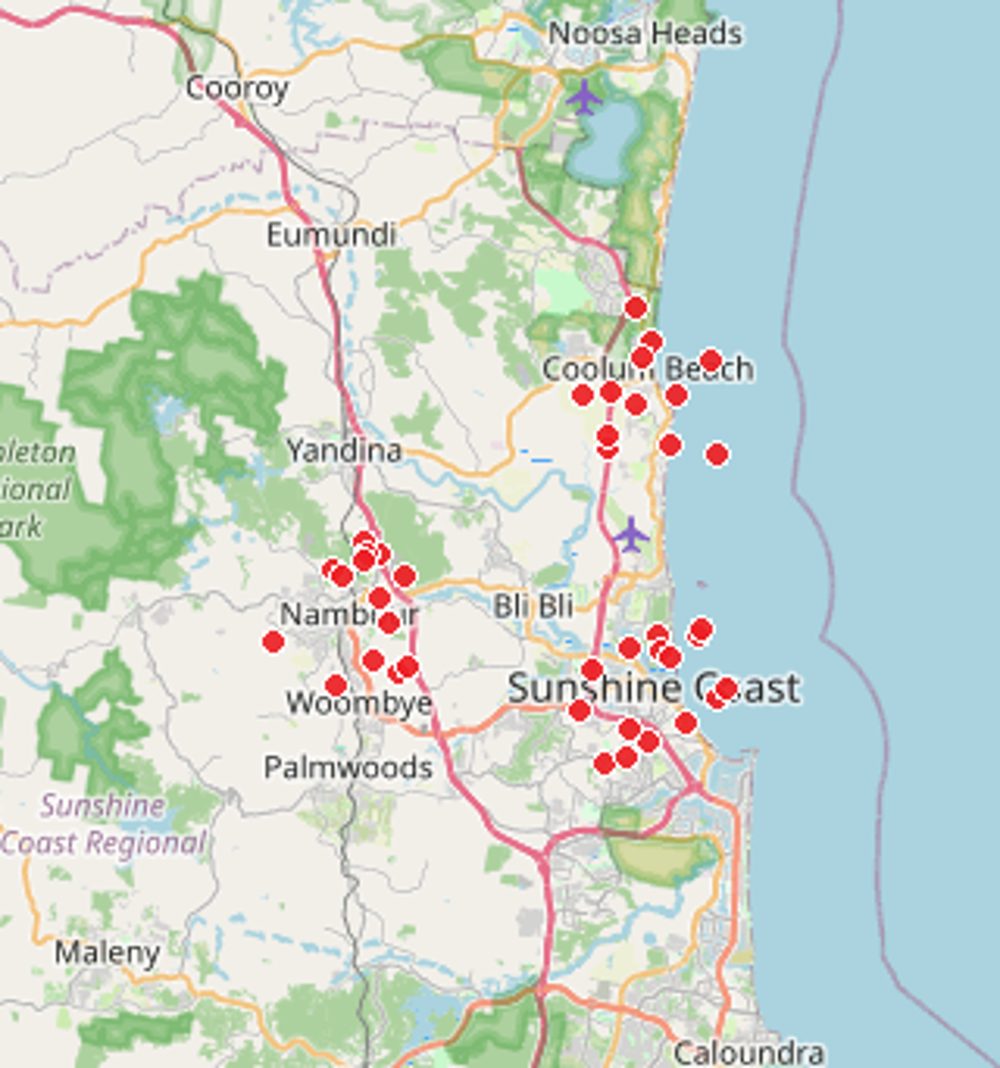
287+ Sunshine Coast homes — and what your neighbours say.
Every red dot on the map is a home near here we’ve quoted, advised or insulated (de-identified) — recent records only, a fraction of what we’ve done since 1986.
From a local
“Very happy, came when they said they would, did the job well, and left everywhere clean and rubbish free.”
“We used Comfort Zone for floor insulation. Good communication, speedy installation and great follow up to ensure I was happy with the end product.”
“Professional and timely service provided by Comfort Zone Insulation for our roof insulation of a small 2 bedroom unit. Thank you!”
The local picture
What Sunshine Coast homes actually need.
On the Sunshine Coast the enemy isn't winter cold. It's the long, humid summer where the temperature barely drops overnight and the air-con runs most of the year. The win here is comfort and humidity control: a quality cellulose ceiling plus good roof ventilation keeps bedrooms cooler and drier through the sticky season and cuts the cooling load coastal homes lean on. And because it's salt-laden coastal air, a breathable, non-corroding cellulose fill handles the damp better than a sealed-up fibreglass batt.
What it costs
What ceiling insulation costs in Sunshine Coast.
As a rough guide, ceiling insulation runs $42–$61/m² including GST, depending on the product, your roof type and how hard the access is. A simple low-set roof with an easy manhole costs less per metre than a cut-up two-storey full of downlights, so I don’t publish one flat number for Sunshine Coast. Send me your address and I’ll measure your roof off Nearmap and give you a proper fixed-price quote within 48 hours, with no deposit to pay.
Recommended prices. Your local Comfort Zone team confirms your exact price in a written fixed-price quote.
Sunshine Coast in brief
Founded
Home of the Kabi Kabi and Jinibara peoples for thousands of years; settled by Europeans from the 1820s as timber towns and jetties, and officially named the 'Sunshine Coast' in the early 1960s
People
342,541 across the region (ABS 2021), in about 149,000 homes — one of Australia's fastest-growing areas
Industry
Tourism, construction, health care and education today; built on timber, dairy, sugar cane and pineapples
Setting
A run of surf coast about 100 km north of Brisbane, backed by the volcanic Glass House Mountains and the cool Blackall Range hinterland
Why Comfort Zone
Cellulose insulation, by the family that makes it.
The only cellulose insulation maker still operating in Queensland.
We manufacture every bag ourselves in our own factory at Tiaro. The other Queensland cellulose makers have closed down over the years — these days our competitors buy their cellulose from us. Choose Comfort Zone and you’re dealing with the family who actually makes the product, start to finish.
We make our own cellulose
Most cellulose insulation sold in Australia is manufactured interstate — in Victoria, South Australia or WA. Ours is made right here in our own Tiaro factory, so you deal with the family who makes it, not a sales rep reselling someone else's product.
Three generations, since 1986
Peter learned the trade from his father, Lyle, and runs the business today with his sons. A real family business that's been insulating Queensland homes for nearly 40 years — not a franchise call-centre.
QR-code batch-tracked bags
Every bag we pump into your roof is QR-coded and tracked back to its production batch and your job — full traceability that even the big national brands can't offer.
Don’t take our word for it
Here’s what Jane, a fellow Sunny Coaster, reckons about us.
Filmed on a real Coolum Beach job — not a paid actor.
Read the transcript
Peter: I've just finished a job here, and I'm talking with Jane about what we did. We insulated her garage — it wasn't insulated before — and I topped up the rest of the job, because the eaves and a few things had been missed. So, Jane, what did you think of our job and our service? Jane: Yeah, excellent job and service, Peter, thanks. We had a huge issue with heat retention in the garage, and that was definitely affecting the two rooms next to it. So hopefully now the insulation's in, we'll notice a great decrease in that temperature in summer. Peter: And you'd had a problem with rodents in the garage too. Jane: Yes, because it wasn't insulated. Hopefully that'll rectify that as well. But everything's been good — very informative, and they cleaned up great. Peter: Thanks very much, Jane.
Sunshine Coast climate
The weather your insulation has to handle.
- A humid coastal climate
- Warm, humid and subtropical, with no real winter and no frost on the coast (NCC Climate Zone 2). At the Sunshine Coast Airport the January average runs 29.1°C by day and 21.3°C overnight (BoM 040861), so insulating up here is about beating summer heat and humidity, not winter cold.
- Days over 30°C (the air-con driver)
- About 30 days a year top 30°C at the Sunshine Coast Airport (BoM 040861), bunched into December to February. Just inland it's hotter still — the long Nambour record runs to around 43 such days a year, because the sea breeze keeps the beach milder than the suburbs behind it.
- Warm, humid summer nights
- January nights barely cool off — a mean overnight minimum of 21.3°C with 9am humidity around 73% (BoM 040861). Those sticky 21-degree nights that never drop away are exactly why coastal bedrooms need a ceiling that blocks the day's stored roof heat.
- Hottest on record
- 41.3°C at the Sunshine Coast Airport on 4 January 2014 (BoM 040861) — nearby Tewantin has touched 41.7°C. On a day like that an uninsulated roof cavity can climb well past 50°C, and all of it radiates straight down through the ceiling.
- Summer humidity
- Consistently muggy — 9am relative humidity averages 69–73% across December to February, and 3pm sits around 69–71% (BoM 040861). Humid air makes the same temperature feel hotter, so a sealed, gap-free ceiling that holds the cool, dry air-conditioned air in really earns its keep.
- Annual rainfall
- A wet, summer-dominant climate — about 1,500 mm a year at the coast and wetter still up on the range, where Nambour averages near 1,700 mm, with February the wettest month (BoM 040861 / 040282).
And it's trending warmer: BoM's State of the Climate reports Australia has heated about 1.5°C since 1910, with more frequent extreme-heat events, and the Queensland Government's projections point to more very hot days above 35°C and warmer nights across South East Queensland this century. A home that's comfortable now will lean on its ceiling insulation and air-conditioning harder every decade — worth getting right once.
Note: Typical figures are from the Sunshine Coast Airport (Marcoola) station; published record extremes weren't available at research time.
Climate outlook reviewed 2026-06-11; local job counts updated 2026-06-26. Sources: BoM: Sunshine Coast Airport · ABCB climate-zone map.
Sunshine Coast at a glance
- Climate zone
- Climate Zone 2 — what R-value that needs
- Postcodes
- 4558, 4573
- Local picture
- Maroochydore (≈20,000) is the Coast's commercial heart and Coolum Beach (≈9,150) a classic beachside community, both heavy users of cooling through the humid season.
The Sunshine Coast is NCC Climate Zone 2. With mild winters and long, humid summers, the win here is comfort and humidity control year-round: a breathable cellulose ceiling plus roof ventilation, not chasing winter R-value.
What Zone 2 actually needs — straight from the NCC
The Sunshine Coast sits in NCC Climate Zone 2, where the code asks for about R2.5 of added ceiling insulation (NCC 2022 Housing Provisions, Part 13.2.3, Table 13.2.3c) — and we install a deep, gap-free R3.0 cellulose blanket as standard, about 20% over the minimum. Our climate is cooling-dominated, so there's no point chasing a giant R-value the weather won't reward; getting the blanket seamless and gap-free across the whole ceiling matters far more, especially under a hot metal roof. Beware quotes citing “R5.5+” as the ceiling figure — that's a whole-of-home “total-system” / NatHERS number for the cold southern states, not what the coast needs.
Read it yourself: NCC 2022 Housing Provisions, Part 13.2.3, Table 13.2.3c — free from the ABCBThe season ahead — and why it matters for your insulation
Mid-2026 trending toward El Niño, warmer and drier for the northern coast. Reviewed each season.
Colder than you think
It’s colder around Sunshine Coast than in it.
The Sunshine Coast splits in two on a climate map. The coastal strip — Maroochydore, Caloundra, Mooloolaba, Noosa — is mild, humid and effectively frost-free; the load on a beachside home is summer heat and humidity. Climb the Blackall Range and it changes. Maleny, Montville and Mapleton sit around 400–450 m up, run several degrees cooler on a winter night, pick up far more rain, and cop the occasional light frost in the sheltered valleys. So a coastal home can get away with a lighter envelope, but a hinterland home faces a genuine cold season and needs a properly insulated, gap-free ceiling — and underfloor on the high-set Queenslanders — to hold the heat in overnight.
| Town | Height | Avg July night | Frosts / year | Avg summer day |
|---|---|---|---|---|
| Maroochydore / Sunshine Coast Airport (coast) | ~4 m | ~9–10°C | None — frost-free coast | ~29°C (Jan) 🔥 |
| Caloundra (coast) | ~5 m | ~9–10°C | None — frost-free coast | ~28°C (Jan) |
| Nambour (foot of the range) | ~15 m | ~8°C | Very rare — odd light frost in low pockets | ~29°C (Jan) |
| Mapleton (hinterland) | ~400 m | ~7°C | Occasional light winter frost | ~26–27°C (Jan) |
| Montville (hinterland) | ~430 m | ~7°C ❄ | Occasional light winter frost | ~26°C (Jan) |
| Maleny (Blackall Range) | ~450 m | ~7°C | Odd light ground frost in sheltered valleys | ~26–27°C (Jan) |
- Elevation is the whole story. Maleny's BoM gauge sits at about 425 m, the Sunshine Coast Airport at just 4 m — and air cools roughly 0.6–1°C for every 100 m you climb, so the range runs about 2–3°C colder than the beach on a typical winter night.
- Winter nights are where it bites. The coast rarely drops below about 9–10°C on a July night, but up on the range the mean July minimum sits near 7°C, and clear, still nights fall lower — cold enough for the odd light frost in sheltered valleys, which the coastal strip effectively never sees.
- Summers are milder up top, not hotter. Despite being inland, the hinterland's height keeps January maximums around 26–27°C against roughly 28–29°C on the coast — the range is the Sunshine Coast's cool retreat, not a hot one.
- It's wetter on the range, too. The hinterland catches the moisture as air is forced up the escarpment — Nambour averages around 1,700 mm a year — so a damp-tolerant, breathable ceiling envelope matters even more up there.
- What it means for insulation: a coastal Maroochydore or Caloundra home is mild and humidity-driven, so the envelope is mostly about summer comfort. A Maleny, Montville or Mapleton home faces a real cold season — those 7°C nights and the odd frost mean a fully insulated, gap-free ceiling (and underfloor on the high-set homes) does real work holding overnight heat in. Same region, two different insulation jobs.
Source: BoM Climate statistics for Australian locations (Sunshine Coast Airport 040861, Maleny Tamarind St 040121, Nambour DPI 040282, Tewantin 040908), long-term station means, pulled 25 June 2026.
A bit about Sunshine Coast
We know this patch.
- The Glass House Mountains — a striking set of ancient volcanic plugs that Lieutenant James Cook named from the water in 1770, and a sacred landscape of the Jinibara and Kabi Kabi peoples — rise straight out of the hinterland behind the coast.
- Australia Zoo at Beerwah, founded by the Irwin family and made world-famous by Steve Irwin the 'Crocodile Hunter', is one of Australia's best-known wildlife attractions, and it's right on our patch.
- The Sunshine Coast's surf beaches — Mooloolaba, Maroochydore, Alexandra Headland, Coolum and Noosa Main Beach — drove the post-war tourism boom that grew a string of little timber towns into one of Australia's fastest-growing regions.
- Noosa is internationally famous, with the coastal headland walks of Noosa National Park and the upmarket Hastings Street precinct — and it heaves with visitors (and heat) every summer holiday.
- The hinterland villages of Maleny, Montville and Mapleton sit up on the Blackall Range — rainforest, waterfalls and sweeping Glass House Mountains views — and run several degrees cooler than the beach, with a genuine cold snap in winter.
Local links: BoM — Sunshine Coast Airport climate statistics (station 040861) · Sunshine Coast Council · University of the Sunshine Coast (UniSC), Sippy Downs · Australia Zoo, Beerwah · Visit Sunshine Coast — official visitor guide
What we’d recommend in Sunshine Coast
The insulation that suits Sunshine Coast homes, and why.

Comfort Zone insulation.team
Family-owned insulation manufacturer, making comfy homes since 1986
Maroochydore and Coolum cop long, sticky summers where the night barely cools. A cellulose ceiling plus roof ventilation keeps bedrooms cooler and drier and trims the year-round cooling bill.

Comfort Zone insulation.team
Family-owned insulation manufacturer, making comfy homes since 1986
Homes near the Sunshine Motorway and the Bruce Highway feeders carry steady traffic noise, and dense cellulose in walls and ceiling absorbs it better than batts.

Comfort Zone insulation.team
Family-owned insulation manufacturer, making comfy homes since 1986
On Coolum's coastal blocks, polyester underfloor handles the damp salt air and adds to year-round comfort under raised floors.
That’s what we see most in Sunshine Coast. But every home is different. Browse all our insulation services or ask for a quoteand we’ll tell you what yours needs.
Underfloor, done right
Underfloor on the Sunshine Coast — but only where it earns its keep
Comfort Zone insulation.team
Family-owned insulation manufacturer, making comfy homes since 1986
Underfloor insulation is one of those jobs where I'll tell you straight up whether it's worth a cent on your place, because for half the Sunshine Coast it simply isn't. If you're in a slab-on-ground home — and that's most of the newer estates like Sippy Downs, Pelican Waters and Peregian Springs — there's nothing to insulate underneath. Your floor is a concrete slab sitting on the dirt, and that slab does its own slow, steady thermal job for you; nobody's getting under it. So if a salesman tries to sell you underfloor on a slab home, show him the door. Where underfloor genuinely earns its keep is the other half of our patch: the high-set timber homes and the old Queenslanders up in the hinterland — Maleny, Montville, Mapleton — where the house is lifted up off the ground on stumps and you've got a timber floor with open air running underneath it.
Here's the physics of why it matters on those high-set homes, and it cuts both ways through the year. In winter, that open subfloor fills up with cold air and the breeze runs straight under your floorboards. The warm air inside your home is forever trying to escape, and a good chunk of it drops down and leaks out through the gaps in the boards and through the floor itself — that's why your feet are cold on a winter morning even with the heater going. In summer it's the same path running the other way: on a stinking-hot day your air-con is working hard to fill the room with cool air, and cool air is heavy, so it sinks and falls straight out through the floor into that open subfloor, and you're effectively air-conditioning the dirt under your house. Insulating snug between the joists slows that drop-out in both seasons, so the heat you've paid to make in winter and the cool you've paid to make in summer both stay up in the room where you're living.
Now the part most installers won't tell you: how it's fitted decides whether you get the R-value on the label or half of it. YourHome is blunt about it — even a small gap greatly reduces the insulation's value, and a floor full of pipes, joists and bracing is exactly where gaps creep in. The industry's own 2024 ICANZ figures back it hard: roughly 6% of gaps will halve the effective R-value, so a rated R2.0 batt fitted with sloppy gaps is really doing R1.0, and you've paid for performance you'll never feel. And it has to stay put — the NCC requires insulation to maintain its position and thickness over time, and underfloor is the one that loves to sag, slip and drop out the bottom within a few seasons if it's not held right. That's why on a suspended timber floor we use a polyester underfloor product, cut snug and fixed up tight against the boards so it holds its position for the life of the house. Get an honest read on your floor type before you spend a dollar: high-set timber or hinterland Queenslander, it's a genuine winner; slab on the ground, save your money for the ceiling where it'll do real work.
Watch: real jobs
See the work for yourself
A few from our own channel: does cellulose really settle, the flame test, and why we pump it in instead of laying batts.
Filmed on real jobs over the years — our methods, safety standards and products have moved on since. Subscribe to the channel for more.
The difference
On a Sunshine Coast roof: what we run into, and how we do it.

Comfort Zone insulation.team
Family-owned insulation manufacturer, making comfy homes since 1986

Comfort Zone insulation.team
Family-owned insulation manufacturer, making comfy homes since 1986
Where we’ve helped — suburb by suburb
446+ Sunshine Coast homes, and the postcode for yours.
Find your suburb below — the number is how many homes near you we’ve helped with advice or work. These are only the last few years we’ve kept digital records for, a fraction of what we’ve done since 1986, so if there’s no count next to your suburb yet, be the first on your street.
Maroochydore, Kawana & Caloundra (4551 · 4556 · 4557 · 4558 · 4575)
267+ homes helped here
- 4556Buderim44 homes
- 4565Tewantin17 homes
- 4558Maroochydore15 homes
- 4560Nambour14 homes
- 4573Coolum Beach12 homes
- 4566Noosaville12 homes
- 4551Pelican Waters11 homes
- 4556Sippy Downs10 homes
- 4551Little Mountain10 homes
- 4551Currimundi9 homes
- 4575Wurtulla7 homes
- 4551Caloundra7 homes
- 4557Mooloolaba7 homes
- 4575Parrearra7 homes
- 4550Landsborough7 homes
- 4551Golden Beach6 homes
- 4564Twin Waters6 homes
- 4567Noosa Heads6 homes
- 4563Cooroy6 homes
- 4575Birtinya5 homes
- 4558Sunshine Coast5 homes
- 4575Minyama4 homes
- 4557Mountain Creek4 homes
- 4575Buddina4 homes
- 4551Aroona4 homes
- 4559Woombye4 homes
- 4561Yandina4 homes
- 4558Kuluin3 homes
- 4575Warana3 homes
- 4555Palmwoods3 homes
- 4572Alexandra Headland2 homes
- 4575Bokarina2 homes
- Meridan Plains2 homes
- 4560Mapleton2 homes
- 4551Moffat Beach1 home
- Dicky Beach1 home
- 4558Cotton Tree1 home
- Shelly Beachbe the first
- Kings Beachbe the first
Noosa & the northern beaches (4564 · 4565 · 4566 · 4567 · 4573)
97+ homes helped here
- 4565Tewantin17 homes
- 4573Coolum Beach12 homes
- 4566Noosaville12 homes
- 4565Cooroibah8 homes
- 4567Sunshine Beach7 homes
- 4564Twin Waters6 homes
- 4567Noosa Heads6 homes
- 4567Sunrise Beach6 homes
- 4564Marcoola4 homes
- 4571Peregian Springs4 homes
- 4573Yaroomba4 homes
- 4571Peregian Beach3 homes
- 4564Mudjimba2 homes
- 4567Castaways Beach2 homes
- 4564Pacific Paradise2 homes
- 4571Marcus Beach1 home
- 4573Point Arkwright1 home
- 4565Boreen Pointbe the first
Nambour, the hinterland & Blackall Range (4552 · 4560 · 4562 · 4563)
82+ homes helped here
- 4560Nambour14 homes
- 4552Maleny9 homes
- 4560Bli Bli9 homes
- 4550Landsborough7 homes
- 4563Cooroy6 homes
- 4553Mooloolah Valley4 homes
- 4561Yandina4 homes
- 4559Woombye4 homes
- 4562Doonan4 homes
- 4574Flaxton4 homes
- 4556Forest Glen3 homes
- 4563Cooran3 homes
- 4555Palmwoods3 homes
- 4574Montville2 homes
- 4560Mapleton2 homes
- 4562Eumundi2 homes
- 4559Diddillibah1 home
- Witta1 home
- 4562Verrierdalebe the first
- 4560Image Flatbe the first
- 4560Coes Creekbe the first
- Kenilworthbe the first
- Conondalebe the first
- 4563Kin Kinbe the first
Counts are de-identified contacts from our records — homeowners we’ve helped with advice or work, not just completed jobs. See the customer map.
Your local team
Sunshine Coast is looked after directly by Comfort Zone HQ — for now.
Right now Sunshine Coast is served straight out of our family HQ and Tiaro factory, the same people who make the cellulose. Every job is done to one standard, photographed, and the photos checked before you’re invoiced.
Want to run Sunshine Coast as your own business?
We’re looking for the right local owner-operator for this patch. If you’re passionate about the building trade — or you already run a business that fits, like air-conditioning, pest control, roofing or solar, and you want a high-margin add-on product to take to the customers you already have — we’ll train you from the ground up. You don’t need insulation experience; you need the right attitude and a patch you want to own. We make the product, we teach you to install and sell it, and you build a family business of your own — backed by the factory.
Sunshine Coast questions
Insulation in Sunshine Coast — your questions, answered.
How much ceiling insulation does a Sunshine Coast home actually need?
The Sunshine Coast is NCC Climate Zone 2, where the added ceiling minimum is about R2.5 (Table 13.2.3c). We install a deep, gap-free R3.0 cellulose blanket as standard. Our climate is cooling-dominated, so there's no point chasing a giant R-value the weather won't reward — what really matters is that the blanket covers the whole ceiling with no gaps, especially under a hot metal roof.
Will ceiling insulation help with the humidity, or just the heat?
Both, and the humidity is the half people forget. Your roof cavity gets brutally hot and muggy through a Sunshine Coast summer, and that sticky air pushes straight down into the rooms below. A sealed, gap-free insulated ceiling keeps that hot, humid roof-space air out and holds the cool, dehumidified air from your air-conditioner in — so the aircon isn't fighting the roof all day, and it runs less.
My place has raked or cathedral ceilings — can you still do those?
Yes, and we do a lot of them up here. Open-beam, raked and cathedral ceilings are common in coastal and hinterland homes, and you can't just lay batts into them. We pump cellulose in to a set density so it fills the whole sloping cavity evenly — there's a video on this page showing exactly how we do an open and raked section.
I'm up in the hinterland (Maleny, Montville, Mapleton) — is it different from the coast?
Very. The Blackall Range runs about 2–3°C colder than the beach on a winter night, cops the odd genuine frost in the valleys, and gets far more rain. Up there you need a proper winter envelope — a sealed, gap-free ceiling, and underfloor insulation if your home is up on stumps — not just the cooling-focused approach that suits a beachside home.
Does underfloor insulation make sense for my Sunshine Coast home?
It depends on your home, and it comes down to what's under your floor. A high-set timber home or a hinterland Queenslander up on stumps — yes, underfloor stops your floorboards going cold in winter and stops the cool air from your aircon dropping out through the floor on a hot day. But a slab-on-ground estate home in Sippy Downs, Pelican Waters or Peregian Springs has nothing to insulate underneath, so save your money for the ceiling. We can tell which one you've got from your details and a couple of photos.
Does cellulose cope with the coastal damp and the pests?
It's well suited to it. Cellulose is breathable and moisture-tolerant, so it handles the high coastal humidity better than sealing everything up tight, and it's borate-treated, so rodents and insects won't nest and live in it the way they do in loose batts — which is exactly the rat-in-the-uninsulated-garage problem one of our Coolum customers had before we did her place.
How do you quote a Sunshine Coast job — do you need to come and inspect it first?
No. After this many years on the tools, Peter quotes the whole job online from your details, so you're not waiting around for a site visit, and you get a detailed, fixed-price quote up front. We don't bump that price when we turn up — if something got missed, that's on us. On the rare job where we're genuinely missing a detail, we'll come and check before we quote. We cover the lot, from Caloundra and Beerwah up through Buderim, Maroochydore and Nambour to Coolum, Noosa and the Blackall Range hinterland.
Had your Sunshine Coast home done? A review helps your neighbours choose well.
A quick honest review genuinely helps a small family business, and helps the next person decide. Thank you.
Got photos or a video from the job? Here’s where to send them →
Get a quote for your Sunshine Coast home.
Tell us your address and a few details and we’ll measure online and send a detailed, fixed-price quote. Phone 0414 586 315.